

I put the mast up and down 6 or 7 times yesterday.
I also had a 60lb youngin jump on the deck behind the mast while I was down below.
All the stays were loose.
I did not see any movement in the main crack (the first picture) while the youngin was jumping. But when I put my thumb on it, I think I can feel movement.
Im not sure what to think...
Separation of the liners / molds: deck, head line, hull liner, hull
-
JamesToBoot
- Engineer
- Posts: 150
- Joined: Thu Aug 14, 2025 11:59 am
- Sailboat: MacGregor 26S
- Location: SC
Re: Separation of the liners / molds: deck, head line, hull liner, hull
-james
Novice Sailor
'91 26S, fixer-upper, 55lb w 280ah lithium, need stern rail
Cruising Grounds: Lake Murray, youtube
Novice Sailor
'91 26S, fixer-upper, 55lb w 280ah lithium, need stern rail
Cruising Grounds: Lake Murray, youtube
-
JamesToBoot
- Engineer
- Posts: 150
- Joined: Thu Aug 14, 2025 11:59 am
- Sailboat: MacGregor 26S
- Location: SC
Re: Separation of the liners / molds: deck, head line, hull liner, hull
-james
Novice Sailor
'91 26S, fixer-upper, 55lb w 280ah lithium, need stern rail
Cruising Grounds: Lake Murray, youtube
Novice Sailor
'91 26S, fixer-upper, 55lb w 280ah lithium, need stern rail
Cruising Grounds: Lake Murray, youtube
-
JamesToBoot
- Engineer
- Posts: 150
- Joined: Thu Aug 14, 2025 11:59 am
- Sailboat: MacGregor 26S
- Location: SC
Re: Separation of the liners / molds: deck, head line, hull liner, hull
Heres a thread with a couple of projects on a 26D, including some deck work around the mast showing the general constuction style of the MacGregor 26c's (26s / 26d).
viewtopic.php?t=29141&hilit=restore+%2Frefit+of+my+1988
viewtopic.php?t=29141&hilit=restore+%2Frefit+of+my+1988
-james
Novice Sailor
'91 26S, fixer-upper, 55lb w 280ah lithium, need stern rail
Cruising Grounds: Lake Murray, youtube
Novice Sailor
'91 26S, fixer-upper, 55lb w 280ah lithium, need stern rail
Cruising Grounds: Lake Murray, youtube
-
Ixneigh

- Admiral
- Posts: 2469
- Joined: Thu Sep 09, 2010 11:00 am
- Sailboat: MacGregor 26M
- Location: Key largo Florida
Re: Separation of the liners / molds: deck, head line, hull liner, hull
Oh good gravy. Do NOT separate the parts. Concur with over easy. Fix each spot with fiberglass from the inside. I’ve done a bunch of glasswork inside, while relocating the head compartment from in front of the main bulk to behind it. And putting in a whole new bulkhead to form the completed new compartment.
The following is my opinion.
Use an angle drill either cordless or not, with roloc style 3 inch discs. These drills turn slower than a grinder. The gel coat grinds off pretty easy. I use a Milwaukee cordless angle drill. That drill is light, the lower rpm throws less dust around. I jury rigged a dust extractor using an outside shop vac and taped the vacuum hose to the drill. Removed almost all the dust. Grind and prep as Overeasy suggested. I differ with resin advice. I use west epoxy if it’s important and there’s wood involved, or vinyl ester if it’s just fiberglass. Do not use “general purpose” resin for structural repairs, esp on old fiberglass. Use almost all glass fabric and very little filler, only for prettying up the final surface. Precut the glass pieces, and prepare in sets of 4. You may need 8 layers of medium thickness fiberglass Matt style fabric. Smallest layer first, like one inch by two inches, then the larger ones. Put that group on a piece of lucite, or other slick plastic. Mix the resin well, vinyl ester will give you a warning if it’s going to set, by beginning to thicken. Cheap stuff won’t! Carefully apply the resin between each piece of fiberglass on the plastic. When you have all of it nice and saturated, carefully peel off the whole shmeel and press the fiberglass layers into the repair and use your brush to squish it in and work out trapped air. Don’t worry a lot about smoothness right now! Do the same with the 2nd grouping. You should now have a bit more fiberglass on there than you need to fill the repair completely. When it dries, grind it flush, and fill minor imperfections with a filling compound. You can make your own from resin, there are how-tos on the web. Then gel coat and done. Stronger than the original. If you get really good at this operation, you hardly even need any filler.
Btw:
You can use the lucite or plastic board trick when working with multiple layers of larger pieces of fiberglass too. Such as, layers of the heavy weight biaxial fiberglass. Wet it out on the board, then peel and stick to (especially vertical or overhead surfaces) this is known as “bonding” iirc
Good luck!
Ix
The following is my opinion.
Use an angle drill either cordless or not, with roloc style 3 inch discs. These drills turn slower than a grinder. The gel coat grinds off pretty easy. I use a Milwaukee cordless angle drill. That drill is light, the lower rpm throws less dust around. I jury rigged a dust extractor using an outside shop vac and taped the vacuum hose to the drill. Removed almost all the dust. Grind and prep as Overeasy suggested. I differ with resin advice. I use west epoxy if it’s important and there’s wood involved, or vinyl ester if it’s just fiberglass. Do not use “general purpose” resin for structural repairs, esp on old fiberglass. Use almost all glass fabric and very little filler, only for prettying up the final surface. Precut the glass pieces, and prepare in sets of 4. You may need 8 layers of medium thickness fiberglass Matt style fabric. Smallest layer first, like one inch by two inches, then the larger ones. Put that group on a piece of lucite, or other slick plastic. Mix the resin well, vinyl ester will give you a warning if it’s going to set, by beginning to thicken. Cheap stuff won’t! Carefully apply the resin between each piece of fiberglass on the plastic. When you have all of it nice and saturated, carefully peel off the whole shmeel and press the fiberglass layers into the repair and use your brush to squish it in and work out trapped air. Don’t worry a lot about smoothness right now! Do the same with the 2nd grouping. You should now have a bit more fiberglass on there than you need to fill the repair completely. When it dries, grind it flush, and fill minor imperfections with a filling compound. You can make your own from resin, there are how-tos on the web. Then gel coat and done. Stronger than the original. If you get really good at this operation, you hardly even need any filler.
Btw:
You can use the lucite or plastic board trick when working with multiple layers of larger pieces of fiberglass too. Such as, layers of the heavy weight biaxial fiberglass. Wet it out on the board, then peel and stick to (especially vertical or overhead surfaces) this is known as “bonding” iirc
Good luck!
Ix
"Shoal Idea"
2011 M, white
Tohatsu 20
South Fl.
2011 M, white
Tohatsu 20
South Fl.
-
JamesToBoot
- Engineer
- Posts: 150
- Joined: Thu Aug 14, 2025 11:59 am
- Sailboat: MacGregor 26S
- Location: SC
Re: Separation of the liners / molds: deck, head line, hull liner, hull
Thank You @Lxneigh
Thanks for confirming OverEasy's advise not to separate the parts.
I read your thread 'relocating the head' a week or two ago. I had contemplated using a name brand vinyl ester laminating resin.
Can you confirm if these cracks are necessary to repair? Are they structual?
Thanks for the breakdown of the process. It is really helpful to read thru another's process to confirm I am understand everything I can before attacking these. I might just try the drill instead of a grinder; sounds less dusty.
Thanks for confirming OverEasy's advise not to separate the parts.
I read your thread 'relocating the head' a week or two ago. I had contemplated using a name brand vinyl ester laminating resin.
Can you confirm if these cracks are necessary to repair? Are they structual?
Thanks for the breakdown of the process. It is really helpful to read thru another's process to confirm I am understand everything I can before attacking these. I might just try the drill instead of a grinder; sounds less dusty.
-james
Novice Sailor
'91 26S, fixer-upper, 55lb w 280ah lithium, need stern rail
Cruising Grounds: Lake Murray, youtube
Novice Sailor
'91 26S, fixer-upper, 55lb w 280ah lithium, need stern rail
Cruising Grounds: Lake Murray, youtube
-
Ixneigh
- Admiral
- Posts: 2469
- Joined: Thu Sep 09, 2010 11:00 am
- Sailboat: MacGregor 26M
- Location: Key largo Florida
Re: Separation of the liners / molds: deck, head line, hull liner, hull
The liner is not structural. It probably does help add a little support to the deck at least on my boat. (M model)
These boats flex to a degree. The liner may fail at the “hard spots” like corners because it’s pretty thin and mostly for a finished look. It’s possible your boat might have had an unusually hard usage, or maybe she was sandwiched between a sea wall and a much larger boat. I would never “raft” my boat between large ones. Or allow another boat to raft to mine if I was alongside a sea wall. (In fact, I’m not rafting up at all because I’m just that antisocial )
)
Some structural opinions:
the Mac’s large open cabin and no full bulkheads make the boat weaker to deformation from forces pushing the sides together than boats equipped with such bulkheads. Macgregor boats also lack the side decks which most other boats have. Such decks are actually very effective structural enhancement. Think of them as deep section girders but they are horizontal in this case not vertical. Each end is braced by the foredeck and (usually) a transverse element under the cockpit or ideally, a bridge deck/bulkhead combo back there somewhere. All of this means that the structure is resistant to side crushing despite the opening where the cabin is.
My keelboat had all of those things, certainly a stought little thing. Get you across miles of open water, she would. But not miles of shallow water. Oh well.
Ix
These boats flex to a degree. The liner may fail at the “hard spots” like corners because it’s pretty thin and mostly for a finished look. It’s possible your boat might have had an unusually hard usage, or maybe she was sandwiched between a sea wall and a much larger boat. I would never “raft” my boat between large ones. Or allow another boat to raft to mine if I was alongside a sea wall. (In fact, I’m not rafting up at all because I’m just that antisocial
) Some structural opinions:
the Mac’s large open cabin and no full bulkheads make the boat weaker to deformation from forces pushing the sides together than boats equipped with such bulkheads. Macgregor boats also lack the side decks which most other boats have. Such decks are actually very effective structural enhancement. Think of them as deep section girders but they are horizontal in this case not vertical. Each end is braced by the foredeck and (usually) a transverse element under the cockpit or ideally, a bridge deck/bulkhead combo back there somewhere. All of this means that the structure is resistant to side crushing despite the opening where the cabin is.
My keelboat had all of those things, certainly a stought little thing. Get you across miles of open water, she would. But not miles of shallow water. Oh well.
Ix
"Shoal Idea"
2011 M, white
Tohatsu 20
South Fl.
2011 M, white
Tohatsu 20
South Fl.
-
JamesToBoot
- Engineer
- Posts: 150
- Joined: Thu Aug 14, 2025 11:59 am
- Sailboat: MacGregor 26S
- Location: SC
Re: Separation of the liners / molds: deck, head line, hull liner, hull
Thanks @lxneigh,
Its good to hear that the deck liner isn't structural. I may leave the cracks as is for now and enjoy the boat. Maybe a project for another year.
Thanks for describing the structure more. The shortcomings of a boat are just as important as its strengths.
Can you explain what's holding the mast from sinking if the deck isn't supported by the liner, and doesn't appear to be supported by a mast support beneath the mast as I see in most keel boats?
Its good to hear that the deck liner isn't structural. I may leave the cracks as is for now and enjoy the boat. Maybe a project for another year.
Thanks for describing the structure more. The shortcomings of a boat are just as important as its strengths.
Can you explain what's holding the mast from sinking if the deck isn't supported by the liner, and doesn't appear to be supported by a mast support beneath the mast as I see in most keel boats?
-james
Novice Sailor
'91 26S, fixer-upper, 55lb w 280ah lithium, need stern rail
Cruising Grounds: Lake Murray, youtube
Novice Sailor
'91 26S, fixer-upper, 55lb w 280ah lithium, need stern rail
Cruising Grounds: Lake Murray, youtube
-
Be Free

- Admiral
- Posts: 1895
- Joined: Fri Nov 23, 2012 6:08 pm
- Sailboat: MacGregor 26X
- Location: Steinhatchee, FL
Re: Separation of the liners / molds: deck, head line, hull liner, hull
Don't you have a compression post in the cabin directly under the mast?
Bill
2001 26X Simple Interest
Honda BF40D
"If I were in a hurry I would not have bought a sailboat." Me
2001 26X Simple Interest
Honda BF40D
"If I were in a hurry I would not have bought a sailboat." Me
-
Ixneigh
- Admiral
- Posts: 2469
- Joined: Thu Sep 09, 2010 11:00 am
- Sailboat: MacGregor 26M
- Location: Key largo Florida
Re: Separation of the liners / molds: deck, head line, hull liner, hull
On my v22.2 there was a square upright piece of wood, a good sized chunk, attached to the edge of the partial bulkhead amidships. It was directly under the mast. That carried the compression loads. On my M model, the dagger board trunk does the same job. Clever of the builders to arrange it that way. There must be some something in your boat which does the same. (If there isn’t then you know why maybe the liner had cracked. But there would also be damage evident on deck)
I concur with sailing the boat for a while first. Take it easy the first day, check out the cracks, check for movement.
You might decide you’d like a different boat after a year of so, and then those cracks will be someone else’s problem
Ix
I concur with sailing the boat for a while first. Take it easy the first day, check out the cracks, check for movement.
You might decide you’d like a different boat after a year of so, and then those cracks will be someone else’s problem
Ix
"Shoal Idea"
2011 M, white
Tohatsu 20
South Fl.
2011 M, white
Tohatsu 20
South Fl.
-
JamesToBoot
- Engineer
- Posts: 150
- Joined: Thu Aug 14, 2025 11:59 am
- Sailboat: MacGregor 26S
- Location: SC
Re: Separation of the liners / molds: deck, head line, hull liner, hull
@Be Free
@lxneigh
Y'all have me digging more.... Here's what I've found:
-The deck is glassed to the liner (the back wall of the flotation compartment above the sink)
-which is through-bolted to a wall with 6 or so bolts (this is the wall that is both the backsplash for the sink & the wall of the head)
-the wall also has a thick trim piece directly under the mast (appears have 6 decent size screws, which are currently missing, to hold the two pieces together)
-the wall and trim piece are through-bolted to the hull liner via the back wall under the sink (the trim piece sits on top of the sink, so it is wedged between the deck liner 'flotation compartment' and the hull liner 'sink')
-the hull liner is glassed to the water ballast tank and centerboard (the areas around the centerboard appear to be quite beefy)
In conclusion, the mast does appear to have a direct line to the hull, though complex. The cracks in the liner, while concerning, do not appear to be in or near the direct line of the mast support structure.
I will reiterate in the next post with some pictures
@lxneigh
Y'all have me digging more.... Here's what I've found:
-The deck is glassed to the liner (the back wall of the flotation compartment above the sink)
-which is through-bolted to a wall with 6 or so bolts (this is the wall that is both the backsplash for the sink & the wall of the head)
-the wall also has a thick trim piece directly under the mast (appears have 6 decent size screws, which are currently missing, to hold the two pieces together)
-the wall and trim piece are through-bolted to the hull liner via the back wall under the sink (the trim piece sits on top of the sink, so it is wedged between the deck liner 'flotation compartment' and the hull liner 'sink')
-the hull liner is glassed to the water ballast tank and centerboard (the areas around the centerboard appear to be quite beefy)
In conclusion, the mast does appear to have a direct line to the hull, though complex. The cracks in the liner, while concerning, do not appear to be in or near the direct line of the mast support structure.
I will reiterate in the next post with some pictures
-james
Novice Sailor
'91 26S, fixer-upper, 55lb w 280ah lithium, need stern rail
Cruising Grounds: Lake Murray, youtube
Novice Sailor
'91 26S, fixer-upper, 55lb w 280ah lithium, need stern rail
Cruising Grounds: Lake Murray, youtube
-
JamesToBoot
- Engineer
- Posts: 150
- Joined: Thu Aug 14, 2025 11:59 am
- Sailboat: MacGregor 26S
- Location: SC
Re: Separation of the liners / molds: deck, head line, hull liner, hull
*musical* the deck is connected to the, deck hull *end musical*
Here's the picture story. Please pardon the construction site, its a mess.
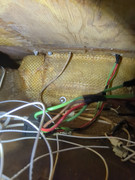
Looking forward into the floatation compartment above the sink. Those are the aft two bolts of the mast step. Here you can see the deck glassed to the liner:
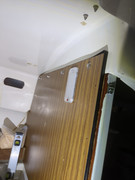
Looking aft into the head you can see the fore most mast step bolts and the other side of the hull liner (floatation compartment)
The liner is bolted to a wall and thick trim piece.
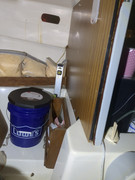
Here is the same view, looking aft into the head, but lower.
The wall and trim piece are bolted to the hull liner (low side wall of the head shown here and back wall of the sink)
Here us the underside of sink, looking forward. Its the other side of the lower head wall from the picture above. Here you can see the liner is glassed to the hull (water ballast and centerboard trunk)

So it does indeed appear the mast is supported down to the hull via several structural parts.
Here's the picture story. Please pardon the construction site, its a mess.
Looking forward into the floatation compartment above the sink. Those are the aft two bolts of the mast step. Here you can see the deck glassed to the liner:
Looking aft into the head you can see the fore most mast step bolts and the other side of the hull liner (floatation compartment)
The liner is bolted to a wall and thick trim piece.
Here is the same view, looking aft into the head, but lower.
The wall and trim piece are bolted to the hull liner (low side wall of the head shown here and back wall of the sink)
Here us the underside of sink, looking forward. Its the other side of the lower head wall from the picture above. Here you can see the liner is glassed to the hull (water ballast and centerboard trunk)
So it does indeed appear the mast is supported down to the hull via several structural parts.
Last edited by JamesToBoot on Wed Aug 27, 2025 4:51 pm, edited 1 time in total.
-james
Novice Sailor
'91 26S, fixer-upper, 55lb w 280ah lithium, need stern rail
Cruising Grounds: Lake Murray, youtube
Novice Sailor
'91 26S, fixer-upper, 55lb w 280ah lithium, need stern rail
Cruising Grounds: Lake Murray, youtube
-
JamesToBoot
- Engineer
- Posts: 150
- Joined: Thu Aug 14, 2025 11:59 am
- Sailboat: MacGregor 26S
- Location: SC
Re: Separation of the liners / molds: deck, head line, hull liner, hull
So... All the cracks, though in near proximity of the mast, do not appear to be in the load line through to the hull.
May I have some of your opinions to confirm or refute my logic?
May I have some of your opinions to confirm or refute my logic?
-james
Novice Sailor
'91 26S, fixer-upper, 55lb w 280ah lithium, need stern rail
Cruising Grounds: Lake Murray, youtube
Novice Sailor
'91 26S, fixer-upper, 55lb w 280ah lithium, need stern rail
Cruising Grounds: Lake Murray, youtube
-
Be Free
- Admiral
- Posts: 1895
- Joined: Fri Nov 23, 2012 6:08 pm
- Sailboat: MacGregor 26X
- Location: Steinhatchee, FL
Re: Separation of the liners / molds: deck, head line, hull liner, hull
I've never been inside an "S" but it looks like that wall is functioning as your compression post. Is the mast centered on it?
The forces on your shrouds and stays that keep the mast from falling over are also trying to rip out your chainplates and shove your mast through the top of the cabin. The chainplates are bolted directly through the hull so they can take care of themselves but there has to be a structural member under the mast that opposes the downward forces or you will find yourself with a keel stepped mast.
The forces on your shrouds and stays that keep the mast from falling over are also trying to rip out your chainplates and shove your mast through the top of the cabin. The chainplates are bolted directly through the hull so they can take care of themselves but there has to be a structural member under the mast that opposes the downward forces or you will find yourself with a keel stepped mast.
Bill
2001 26X Simple Interest
Honda BF40D
"If I were in a hurry I would not have bought a sailboat." Me
2001 26X Simple Interest
Honda BF40D
"If I were in a hurry I would not have bought a sailboat." Me
-
JamesToBoot
- Engineer
- Posts: 150
- Joined: Thu Aug 14, 2025 11:59 am
- Sailboat: MacGregor 26S
- Location: SC
Re: Separation of the liners / molds: deck, head line, hull liner, hull
@Be Free
Yes Sir, it does appear that the mast is centered over the structure, in a straight line down to the centerboard (hull).
Your answer was how this rabbit hole got started... I could not figure out where the loads from the mast were going except into the badly cracked liner (it has what looks like structural C channels crossing the boat). So like some other boats, I had assumed that there wasn't a compression post and set out to find the best way to reinforce the cracked liner.
I am much more comfortable that when this journey began and have settled nicely into believing the cracks are not structural support for the mast, but are flexing of the boat.
It appears we have reached the end of this journet and the current solution is to do nothing, as it doesn't appear any fix is needed to safely enjoy the boat (as pertains to this issue).
Do you agree or have a differing opinion?
Yes Sir, it does appear that the mast is centered over the structure, in a straight line down to the centerboard (hull).
Your answer was how this rabbit hole got started... I could not figure out where the loads from the mast were going except into the badly cracked liner (it has what looks like structural C channels crossing the boat). So like some other boats, I had assumed that there wasn't a compression post and set out to find the best way to reinforce the cracked liner.
I am much more comfortable that when this journey began and have settled nicely into believing the cracks are not structural support for the mast, but are flexing of the boat.
It appears we have reached the end of this journet and the current solution is to do nothing, as it doesn't appear any fix is needed to safely enjoy the boat (as pertains to this issue).
Do you agree or have a differing opinion?
-james
Novice Sailor
'91 26S, fixer-upper, 55lb w 280ah lithium, need stern rail
Cruising Grounds: Lake Murray, youtube
Novice Sailor
'91 26S, fixer-upper, 55lb w 280ah lithium, need stern rail
Cruising Grounds: Lake Murray, youtube
-
JamesToBoot
- Engineer
- Posts: 150
- Joined: Thu Aug 14, 2025 11:59 am
- Sailboat: MacGregor 26S
- Location: SC
Re: Separation of the liners / molds: deck, head line, hull liner, hull
Another tread with a similar issue:
https://macgregorsailors.com/forum/view ... 6s#p342585
https://macgregorsailors.com/forum/view ... 6s#p342585
-james
Novice Sailor
'91 26S, fixer-upper, 55lb w 280ah lithium, need stern rail
Cruising Grounds: Lake Murray, youtube
Novice Sailor
'91 26S, fixer-upper, 55lb w 280ah lithium, need stern rail
Cruising Grounds: Lake Murray, youtube