

So that stub keel on my boat requires that it be up five inches from the OEM bunks I added wood to my trailer supports. I’ve seen where trailers sometimes have a drop down in the middle of the axle. The rear cross beam would also need that treatment.
Thoughts on this? Would the average trailer shop be able to do that or do a need a welding shop?
Ix
Keel slot in axle
-
OverEasy
- Admiral
- Posts: 2873
- Joined: Mon Sep 28, 2020 11:16 am
- Sailboat: MacGregor 26X
- Location: NH & SC
Re: Keel slot in axle
Hi!
Have you thought about simply raising up the bunks to get the clearance needed for your stub keel?
Even if you needed new bunk supports it would be simpler, less pensive and less risk than getting an axle cut and re-welded.
Depending upon your trailer configuration, Some 6x6 pressure treated lumber bolted securely on your existing bunk brackets would provide you with a 5-1/2 inch height rise. (Note: The 6x6 adds stability foot print when placed upon the existing bunks whether they are the traditional side-to-side Original Mac trailer style or the fore-aft bunks of standard aftermarket conventional trailer styles.)
The 5-or-6 plus inches you seem to need isn’t all that much of an increase but you need to be aware of the slightly increased CG height when trailering down the highways…going slower and taking gentle turns.
The slight increase in height would generally have a minor impact on how far one would need to back in the trailer when launching and retrieving your Mac from the water.
This is just from my personal perspective that a bolt-on lumber approach would be adequate, less challenging and costly to accomplish with what I have available (even with a DC stick welder and professional welding experience).
The addition of new contact carpet covers over the new bunk surfaces is a final aspect to plan for if going this route.
Best Regards,
Over Easy
Have you thought about simply raising up the bunks to get the clearance needed for your stub keel?
Even if you needed new bunk supports it would be simpler, less pensive and less risk than getting an axle cut and re-welded.
Depending upon your trailer configuration, Some 6x6 pressure treated lumber bolted securely on your existing bunk brackets would provide you with a 5-1/2 inch height rise. (Note: The 6x6 adds stability foot print when placed upon the existing bunks whether they are the traditional side-to-side Original Mac trailer style or the fore-aft bunks of standard aftermarket conventional trailer styles.)
The 5-or-6 plus inches you seem to need isn’t all that much of an increase but you need to be aware of the slightly increased CG height when trailering down the highways…going slower and taking gentle turns.
The slight increase in height would generally have a minor impact on how far one would need to back in the trailer when launching and retrieving your Mac from the water.
This is just from my personal perspective that a bolt-on lumber approach would be adequate, less challenging and costly to accomplish with what I have available (even with a DC stick welder and professional welding experience).
The addition of new contact carpet covers over the new bunk surfaces is a final aspect to plan for if going this route.
Best Regards,
Over Easy
-
Ixneigh

- Admiral
- Posts: 2462
- Joined: Thu Sep 09, 2010 11:00 am
- Sailboat: MacGregor 26M
- Location: Key largo Florida
Re: Keel slot in axle
I did raise the bunks, and they do work ok. But I saw a trailer with those cutouts and wondered about them. I do notice the added height when launching at the free “ramp” though. Before I could do it at half tide. Now, it needs to be high.
"Shoal Idea"
2011 M, white
Tohatsu 20
South Fl.
2011 M, white
Tohatsu 20
South Fl.
-
Be Free

- Admiral
- Posts: 1891
- Joined: Fri Nov 23, 2012 6:08 pm
- Sailboat: MacGregor 26X
- Location: Steinhatchee, FL
Re: Keel slot in axle
The axles are manufactured that way as are the cross beams. I'm not sure if your cross members are bolted or welded but if they are bolted they could be easily (but not inexpensively) replaced.
You can't just put the bend in an existing cross member or axle. Even if you found a shop that could do it you would end up with something too narrow for your trailer.
You can't just put the bend in an existing cross member or axle. Even if you found a shop that could do it you would end up with something too narrow for your trailer.
Bill
2001 26X Simple Interest
Honda BF40D
"If I were in a hurry I would not have bought a sailboat." Me
2001 26X Simple Interest
Honda BF40D
"If I were in a hurry I would not have bought a sailboat." Me
-
Ixneigh
- Admiral
- Posts: 2462
- Joined: Thu Sep 09, 2010 11:00 am
- Sailboat: MacGregor 26M
- Location: Key largo Florida
Re: Keel slot in axle
It’s the trailer my M model was sold with. It only has the back cross beam which is aluminum and the axle. I’m willing to buy a new axle. I had thought the cross beam could be welded.
I have to do two things in order not have to downsize into either sub 20 foot day sailor or no boat at all. I have to make launching easy as possible and ditto the mast raising.
I’d
I have to do two things in order not have to downsize into either sub 20 foot day sailor or no boat at all. I have to make launching easy as possible and ditto the mast raising.
I’d
"Shoal Idea"
2011 M, white
Tohatsu 20
South Fl.
2011 M, white
Tohatsu 20
South Fl.
-
OverEasy
- Admiral
- Posts: 2873
- Joined: Mon Sep 28, 2020 11:16 am
- Sailboat: MacGregor 26X
- Location: NH & SC
Re: Keel slot in axle
Hi Ixneigh!
There a couple options available if your objective is shallow water launching (low tide).
A trailer tongue extension has been an approach that has been done in several instances for deeper keel boats.
> Some have done it with sleeved telescoping box beam tubes.
> Some have done it with swing out bolted/pinned flange plate junctions.
These allow the boat to be moved in to the water without getting the tow vehicle’s wheels or frame wet.
> Some have made a “tilt” type arrangement where the bow end can be raised while the trailer frame is still connected at the hitch point.
>>>> The trick there is to support the bow as it moves during the loading and unloading process with a ramp like structure. There is also the aspect when loading to provide an inline pull via the winch to help get it onto the trailer sufficiently. This could be done via a pulley that moves with the ramp like arrangement.
There are several commercially produced over the years that are available on the used market that might fit to your needs.
I’d think you’d want to look at longitudinal bunk types rather than roller types (due to rollers being a very limited point loading in the relatively thin hull).
As some old foggey once said “There is nothing new under the sun” and “Necessity is the Mother of invention”…. among others.
There a couple options available if your objective is shallow water launching (low tide).
A trailer tongue extension has been an approach that has been done in several instances for deeper keel boats.
> Some have done it with sleeved telescoping box beam tubes.
> Some have done it with swing out bolted/pinned flange plate junctions.
These allow the boat to be moved in to the water without getting the tow vehicle’s wheels or frame wet.
> Some have made a “tilt” type arrangement where the bow end can be raised while the trailer frame is still connected at the hitch point.
>>>> The trick there is to support the bow as it moves during the loading and unloading process with a ramp like structure. There is also the aspect when loading to provide an inline pull via the winch to help get it onto the trailer sufficiently. This could be done via a pulley that moves with the ramp like arrangement.
There are several commercially produced over the years that are available on the used market that might fit to your needs.
I’d think you’d want to look at longitudinal bunk types rather than roller types (due to rollers being a very limited point loading in the relatively thin hull).
As some old foggey once said “There is nothing new under the sun” and “Necessity is the Mother of invention”…. among others.
-
Be Free
- Admiral
- Posts: 1891
- Joined: Fri Nov 23, 2012 6:08 pm
- Sailboat: MacGregor 26X
- Location: Steinhatchee, FL
Re: Keel slot in axle
I'd hate to see you go. Let's see if we (collectively) can come up with some ideas.
If I remember correctly, you usually launch without the aid of an improved boat ramp so you need to start out as close to the water as possible. Your shallow water keel required you to raise the bunks and you are looking for a way to get the boat as close (or closer) to the water as it was before you raised it up. If that's not correct then feel free to ignore all that follows.
If getting the boat offshore a few more feet would let you attain a more comfortable launching depth then you might consider a removable tongue extension. That would be the easiest and least expensive way if another 4' or so would do the trick.
Smaller diameter wheels will lower the whole rig. Every inch decrease in diameter will lower the trailer 1/2 inch. Smaller wheels make the bearings spin faster and wear out faster. If you don't trailer far that is probably not an issue.
If your axle is attached below your springs you may be able to move it to an "underslung" position between the spring and the frame. It won't make a big difference but it will lower the entire trailer by the thickness of the springs and the radius of the axle. Keep in mind it also reduces your spring travel by the same amount. If you have torsion axles instead of springs then this is not applicable.
Swapping out the axle for a "bent" version is expensive but easy. There are many sources for new axles. When I was replacing mine I saved a lot of money by driving to Clearwater to the Magic Tilt factory in Clearwater (no shipping).
The same goes for replacing the rear cross member. If it is bolted on (common on aluminum trailers) then it's easier than replacing an axle. If it's welded then it gets a little more complicated unless you are one of those wizards who can weld aluminum. (I'm barely competent with iron.) Assuming you can source a properly "bent" member, could you get one that could be slipped over a "stub" of your original member or perhaps use an internal sleeve that could be bolted to the stub and the new member.
Your other goal was to make mast raising easier. What are you using now?
If I remember correctly, you usually launch without the aid of an improved boat ramp so you need to start out as close to the water as possible. Your shallow water keel required you to raise the bunks and you are looking for a way to get the boat as close (or closer) to the water as it was before you raised it up. If that's not correct then feel free to ignore all that follows.
If getting the boat offshore a few more feet would let you attain a more comfortable launching depth then you might consider a removable tongue extension. That would be the easiest and least expensive way if another 4' or so would do the trick.
Smaller diameter wheels will lower the whole rig. Every inch decrease in diameter will lower the trailer 1/2 inch. Smaller wheels make the bearings spin faster and wear out faster. If you don't trailer far that is probably not an issue.
If your axle is attached below your springs you may be able to move it to an "underslung" position between the spring and the frame. It won't make a big difference but it will lower the entire trailer by the thickness of the springs and the radius of the axle. Keep in mind it also reduces your spring travel by the same amount. If you have torsion axles instead of springs then this is not applicable.
Swapping out the axle for a "bent" version is expensive but easy. There are many sources for new axles. When I was replacing mine I saved a lot of money by driving to Clearwater to the Magic Tilt factory in Clearwater (no shipping).
The same goes for replacing the rear cross member. If it is bolted on (common on aluminum trailers) then it's easier than replacing an axle. If it's welded then it gets a little more complicated unless you are one of those wizards who can weld aluminum. (I'm barely competent with iron.) Assuming you can source a properly "bent" member, could you get one that could be slipped over a "stub" of your original member or perhaps use an internal sleeve that could be bolted to the stub and the new member.
Your other goal was to make mast raising easier. What are you using now?
Bill
2001 26X Simple Interest
Honda BF40D
"If I were in a hurry I would not have bought a sailboat." Me
2001 26X Simple Interest
Honda BF40D
"If I were in a hurry I would not have bought a sailboat." Me
-
Be Free
- Admiral
- Posts: 1891
- Joined: Fri Nov 23, 2012 6:08 pm
- Sailboat: MacGregor 26X
- Location: Steinhatchee, FL
Re: Keel slot in axle
Changing from overslung to underslung will be the thickness of the springs plus the diameter of the axle. Not much difference but I expect every inch matters.
Bill
2001 26X Simple Interest
Honda BF40D
"If I were in a hurry I would not have bought a sailboat." Me
2001 26X Simple Interest
Honda BF40D
"If I were in a hurry I would not have bought a sailboat." Me
-
Ixneigh
- Admiral
- Posts: 2462
- Joined: Thu Sep 09, 2010 11:00 am
- Sailboat: MacGregor 26M
- Location: Key largo Florida
Re: Keel slot in axle
I’ll get a new axel maybe this year. I can buy the aluminum and bolt the cross bar together myself. Or pay the ship across the street to weld it. I also need to look into one of those those trailer Dollie’s so I can get the boat in and out of her spot easier. I had a gimpy one but it can’t really move the trailer across gravel. Or maybe a front bumper hitch???
Regarding the mast, when everything works right it’s ok. But the current winch is just at my strength limit now. There is always some snag somewhere too. This last time I taped the wires and lines in place to keep them from catching on things, but then forget to put the new jib halyard on. (Which works good btw)
I only put the mast up once per year, so thats one saving grace.
Regarding the mast, when everything works right it’s ok. But the current winch is just at my strength limit now. There is always some snag somewhere too. This last time I taped the wires and lines in place to keep them from catching on things, but then forget to put the new jib halyard on. (Which works good btw)
I only put the mast up once per year, so thats one saving grace.
"Shoal Idea"
2011 M, white
Tohatsu 20
South Fl.
2011 M, white
Tohatsu 20
South Fl.
-
OverEasy
- Admiral
- Posts: 2873
- Joined: Mon Sep 28, 2020 11:16 am
- Sailboat: MacGregor 26X
- Location: NH & SC
Re: Keel slot in axle
Here’s something that might be of interest to you found on Amazon…
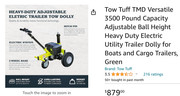
Might be able to help in the boat yard ….. on level ground.
Might be able to help in the boat yard ….. on level ground.
-
Ixneigh
- Admiral
- Posts: 2462
- Joined: Thu Sep 09, 2010 11:00 am
- Sailboat: MacGregor 26M
- Location: Key largo Florida
Re: Keel slot in axle
That looks really awesome. I know what I want for Christmas. !!
"Shoal Idea"
2011 M, white
Tohatsu 20
South Fl.
2011 M, white
Tohatsu 20
South Fl.
-
OverEasy
- Admiral
- Posts: 2873
- Joined: Mon Sep 28, 2020 11:16 am
- Sailboat: MacGregor 26X
- Location: NH & SC
Re: Keel slot in axle
Hi Ixneigh!
They also make a gas powered version for a good bit more….$$$
On another aspect…
I’ve seen guys put a pair of larger diameter wide inflatable tires replacing the standard type of trailer jack wheels and then rig up a bidirectional controlled winch to the truck bumper. This allowed the loaded/unloaded trailer to roll on soft surfaces.
As I recall (it’s been a while),the instance I observed the process was:
> back down the ramp
> large chocks under the trailer wheels
> lower the trailer jack with the larger wide tire set… added a T-handle to steer the wheel set
> uncouple the trailer leaving the safety chains on
> pull truck forward till chains take up the strain of the trailer
> hook on the cable from the winch
> remove the trailer wheel chocks
> gradually release the cable from the winch lowering the trailer down the ramp… ( they were helping it along but gravity seemed to do most of the work )
I gather (guess) that retrieval was just a reversal of the process.. I don’t recall seeing that part
I’m not advocating or criticizing their approach …it’s just something observed a long time ago…
Best Regards,
Over Easy
They also make a gas powered version for a good bit more….$$$
On another aspect…
I’ve seen guys put a pair of larger diameter wide inflatable tires replacing the standard type of trailer jack wheels and then rig up a bidirectional controlled winch to the truck bumper. This allowed the loaded/unloaded trailer to roll on soft surfaces.
As I recall (it’s been a while),the instance I observed the process was:
> back down the ramp
> large chocks under the trailer wheels
> lower the trailer jack with the larger wide tire set… added a T-handle to steer the wheel set
> uncouple the trailer leaving the safety chains on
> pull truck forward till chains take up the strain of the trailer
> hook on the cable from the winch
> remove the trailer wheel chocks
> gradually release the cable from the winch lowering the trailer down the ramp… ( they were helping it along but gravity seemed to do most of the work )
I gather (guess) that retrieval was just a reversal of the process.. I don’t recall seeing that part
I’m not advocating or criticizing their approach …it’s just something observed a long time ago…
Best Regards,
Over Easy
-
Ixneigh
- Admiral
- Posts: 2462
- Joined: Thu Sep 09, 2010 11:00 am
- Sailboat: MacGregor 26M
- Location: Key largo Florida
Re: Keel slot in axle
Actually what I really need is to decouple the trailer and use that wheel jack thing to back it into the spot which only has a few feet on either side. It needs to be able to roll the boat back into the spot on gravel though. It’s also narrow street out front with inches to spare if it’s done just right.
Ix
Ix
"Shoal Idea"
2011 M, white
Tohatsu 20
South Fl.
2011 M, white
Tohatsu 20
South Fl.