Hi Fredthorn!
Congratulations of your work.
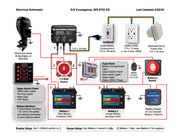
If I might make a couple of suggestions to make your system a bit safer… I agree with BeFree… this is not to say anything other than there are ways to improve and make a system safer, more durable and easier to use.
Boats should be considered somewhat moist locations as condensation and potential water intrusion can be expected in the normal course of operations.
With that in mind here are a couple things to consider/reconsider for your safety and future enjoyment:
- It’s a standard safety requirement that AC electrical system components be within their own dedicated enclosure, not out in the open.
>>> accidentally crossing or contact of an AC terminal isn’t something one want to happen and efforts taken to avoid those potential issues
- AC circuits should be physically separated from DC circuits in separate enclosures.
>>> accidental crossing of an AC circuit voltage into a DC circuit can not only damage equipment but cause personal harm and injury.
- Lead-Acid batteries give off hydrogen and oxygen gas when being charged which in the confined space of a battery compartment with active electrical components could prove hazardous.
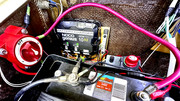
>>> General practice is to keep active electrical components like battery chargers and AC outlets outside of and away from batteries.
>>> Good practice is to provide positive ventilation of battery compartments
- Lead-Acid batteries also have the potential to give off corrosive acidic fumes that may damage/compromise active electrical components such as chargers and outlets. The acidic vapor corrosion byproducts are conductive and may lead to bridged or short circuits contributing to possible damage or overheating.
>>> Good practice is to have separated compartments for batteries and electrical components.
>>> Good practice is to provide positive ventilation of battery compartments
>>> Good practice is to provide positive ventilation or open area for electrical components that may generate heat such as may be the case for a battery charger
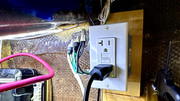
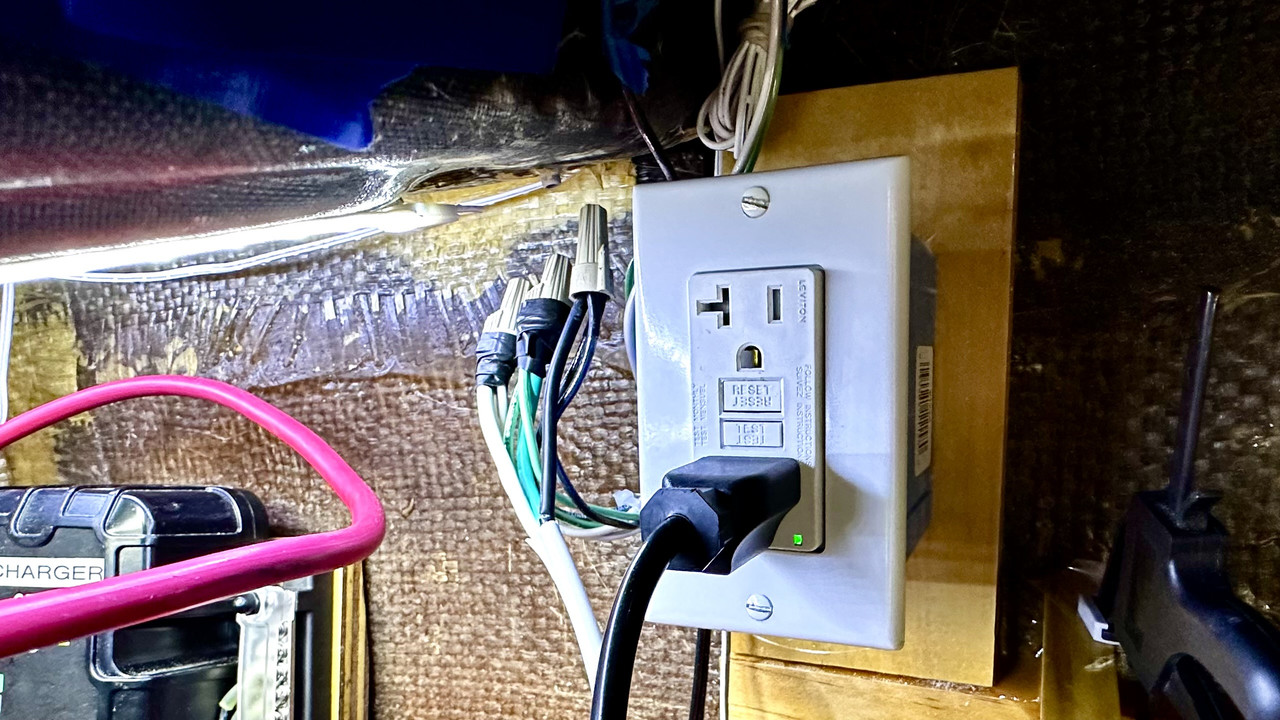
- It’s not to electrical standards to pigtail a lead to an outlet as shown in the photo.
>>> While the electrical taping is of good intention it appears to be only on the ground and common and not the ‘hot’ lead.
Note: There are wire nuts specifically designed for ‘damp’ locations that have a ‘built in’ water barrier of dielectric grease and a pseudo diaphragm to hold that material in place.

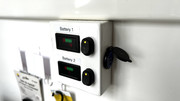
- Standard practice is to have battery isolation switches in readily accessible locations without the need to remove/reposition ancillary materials that could block access to those switches or to have such isolation devices outside of normal view or access.
- Standard practice is to incorporate some type of direct current limiting device such as a fuse or non-automatic resettable breaker in the immediate vicinity of positive battery terminal to preclude a dead short … this is particularly important when a paired set of battery leads are run from where the battery is to where the primary interface/isolation is located (such as when one battery is under a fwd berth and the leads run aft to the other battery and isolator by the companionway.
I see that you did utilize covered distribution strips which is great!
I can also see that there do not appear to be any directly open AC electrical terminal in the photos.
The battery buckets are a good aspect to contain and/or manage any battery fluid leakage.
I am concerned about the battery terminal block with several lead terminations. That can be problematic for a couple of reasons… it would be better to take a primary lead to a separate distribution terminal strip or bus bar. Multiple leads to a common post tends to loosen over time and degrades the electrical contact which increases resistance and terminal heating.
All of the things mentioned are done so out of concern and professional experience.
They are also things that can be accomplished without much duress or effort and provide you with a safer and reliable boat for your use and enjoyment.
Best Regards,
Over Easy