



Dave,DaveC426913 wrote: ↑Thu Oct 26, 2023 6:55 pmGood point. Things are never so simple.
Boating in Toronto Harbour
"Beyond the usual rules of giving the right-of-way to sailboats, special preference should be given to commercial ships coming in and out of the port, as they aren’t afforded the same level of agility as a smaller pleasure craft. Float planes should also be given the right-of-way as they are committed to a specific flight path which they cannot deviate from. This also goes for the ferry travelling to and from Billy Bishop airport. Causing the ferry to change its course will not bode well for your enjoyment of the day."
https://www.autotrader.ca/editorial/202 ... o-harbour/
A lotta "should"s in there...
Also, I thought they had deprecated the term "right-of-way". To make it clear that no vessel has a "right" to right-of-way.
I always remember rule zero: "Thou shalt not collide with another vessel, nor through inaction, allow a collision to occur."
Both vessels must do everything in their power to avoid a collision.

Give me a moment.Be Free wrote: ↑Sat Oct 28, 2023 7:58 pmCan you please cite your source for the statement that "in the U.S. you are not the stand on vessel when it comes to commercial vessels"?NiceAft wrote: ↑Wed Oct 25, 2023 11:48 am Dave,
I don’t know Canadian maritime law, but in the U.S. you are not the stand on vessel when it comes to commercial vessels.
For those who have never tried to have a leisurely cruise on a busy large city harbor, it can be quite an experience. Up close those large tankers are intimidating. They are upon you quickly.
Be Free,Be Free wrote: ↑Sat Oct 28, 2023 7:58 pmCan you please cite your source for the statement that "in the U.S. you are not the stand on vessel when it comes to commercial vessels"?NiceAft wrote: ↑Wed Oct 25, 2023 11:48 am Dave,
I don’t know Canadian maritime law, but in the U.S. you are not the stand on vessel when it comes to commercial vessels.
For those who have never tried to have a leisurely cruise on a busy large city harbor, it can be quite an experience. Up close those large tankers are intimidating. They are upon you quickly.

This is the goal.When you do get someone to answer please ask that they can cite an authoritative source as well. They should be able to cite rule, regulation, or statute to back up their answer.
Dave,DaveC426913 wrote: ↑Tue Nov 14, 2023 2:49 pm
- Sure it does. The entire rule books of both motoring and boating are expressly a summary of how to accomplish the task of not crashing into other vehicles. It's their one job.
- The point of rule zero is that it is overarching. All other procedures are secondary to avoiding a collision, and that too is direction for solutions. To-wit: do anything necessary - that implicitly includes breaking other minor rules. (For example, if, say, veering into a restricted area is the only way to avoid a collision, you are obliged to do so.) That's direction to a solution.
- The other function of rule zero is to ensure you cannot use "I had right-of-way" as a defense. If a collision occurs, and your defense is "I had right-of-way", you are still at-fault. You are obliged to take any action necessary to avoid collision.
OK, here is Rule zero, spelled out (in my interpretation):Be Free wrote: ↑Wed Nov 15, 2023 9:55 pm I think we are talking past one another here. I don't disagree that "rule zero" summarizes the intent and heart of both the motor vehicle and marine regulations regarding avoiding collisions. My contentions is that the statement, "Thou shalt not collide with another vessel, nor through inaction, allow a collision to occur" is not enough. It only provides the goal; it gives no instructions as to how the goal is to be achieved.
Disagree. I can refute that with any situation where rule zero and any other rule are in conflict.


You guys might find this podcast about recent Coast guard cuts interesting:NiceAft wrote: ↑Fri Nov 03, 2023 1:44 pmBe Free,Be Free wrote: ↑Sat Oct 28, 2023 7:58 pmCan you please cite your source for the statement that "in the U.S. you are not the stand on vessel when it comes to commercial vessels"?NiceAft wrote: ↑Wed Oct 25, 2023 11:48 am Dave,
I don’t know Canadian maritime law, but in the U.S. you are not the stand on vessel when it comes to commercial vessels.
For those who have never tried to have a leisurely cruise on a busy large city harbor, it can be quite an experience. Up close those large tankers are intimidating. They are upon you quickly.
Not avoiding responding to your request.
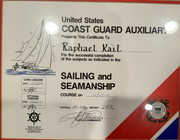
As I said, I took the Coast Guard Auxillary Sailing and Safety course twenty years ago. I forgot that it is the “Sailing and Seamanship” course. Anyway, I was taught what I said about sailboats being the stand on vessels.
Since I have not been able to dig out the lesson pages, I decide to call the Coast Guard and the Coast Guard auxiliary. I have not been able to get return calls to a variety of messages. I tried e-mailing, and still no replies. Today I drove down to the Coast Guard Office in Philadelphia. I arrived at 2:30 on a Friday, and was told the offices were empty; everyone left for the weekend. They took my number and said I would receive a call.
I am trying, and I am not giving up.
Before I left, my wife said to call first. I responded, “This is the Coast guard, they don’t close!” Yeh, right.
I hope that I've not given you the impression that I subscribe to the attitude above.DaveC426913 wrote: ↑Thu Nov 16, 2023 8:36 pm And anyone who can't or won't take ultimate responsibility for their actions - who says "I was following the rules!" as their defense - has no business operating a vehicle.
This may be getting close to the heart of our differences. I would say that the "how" is "You must use your brain intelligently to sort which rule to apply in the current circumstances.."DaveC426913 wrote: ↑Thu Nov 16, 2023 8:36 pm The "how" you ask for is "You must use your brain intelligently to sort good-time-to-follow-that-rule from bad-time-to-follow-that-rule."
I don't believe that there is any part of COLREGS that conflicts with "rule zero". They both have the same goal, "don't collide with stuff". There is no conflict.DaveC426913 wrote: ↑Thu Nov 16, 2023 8:36 pm Disagree. I can refute that with any situation where rule zero and any other rule are in conflict.
We are almost in agreement here. You are supposed to sort-of break the rules sometimes, but that is because the rules specifically allow you to vary from the norm under certain, specified circumstances. But is that technically breaking them? You can't just jump from "I'm on a collision course" to "there is nothing to do but break the rules" without giving the rules time to work.DaveC426913 wrote: ↑Thu Nov 16, 2023 8:36 pm
Just one of an unlimited number of examples:
COLREGS (in this hemisphere) tell you that you should stay on the right side of a channel and pass with red marker on your right when going upstream. That's what you're supposed to do according to COLREGs.
But - if that puts you on a collision course with another vessel, and you had no other way to avoid it except to break the above rule - you are to break the above rule - even moving into the left side of the channel and putting the red marker on your left. If not, you will surely be considered at least partially at-fault.
This is true of virtually any safety rule in the book. It follows inevitably that any-and-all-rules are secondary to rule zero.
I will concede that if you find yourself in a situation where either through malice or negligence another vessel is threatening you and due to circumstances you are incapable of any action that can improve the situation there is nothing you can do (by definition).DaveC426913 wrote: ↑Thu Nov 16, 2023 8:36 pm
The only exception I can think of (and it's not really an exception) is when you have to choose between two outcomes, both of which are a direct and immediate risk to safety. (For example, say you are assisting a downed skier at the transom of your boat and another boat is approaching on a collision course. Perhaps, you could avoid a collision by throwing your motor in gear and getting out the way - but only at the much greater risk of injuring the skier in the water.)
Yeah?
Ray,
I was thinking more in terms of Boat B coming downstream and, for whatever reason, not where he's supposed to be (maybe he's accidentally put it in gear and gunned it out of his slip). It doesn't matter because Boat A has no time to assess what Boat B is doing or what it should be doing or even where it's going next . All he knows is that, if he doesn't veer into the oncoming traffic, he's going to collide.Be Free wrote: ↑Sun Nov 19, 2023 12:31 am Your example has Boat A on on the right side of a channel on a collision course with Boat B. I'm going to stick to power driven vessels just to keep it shorter but it works with any mix of vessels.
Scenario 1: Boat A is overtaking Boat B and will collide with Boat B if nothing is done. If it's not a narrow channel the pass him on the left.
Absolutely correct. That is why I am trying to acquire the printed version. I believe everyone should take the Coast Guard course. I know what I was taught, and since Be Free disagrees with that, it’s important to see what is written. We both can’t be correct.It is a good idea to be familiar with them. They are incorporated in most state boating laws in whole or in essence.
