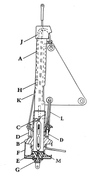
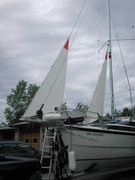
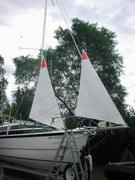
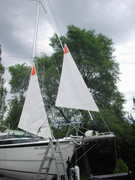
Based on this technical drawing of the CDI roller furler (courtesy BWY), it appears that the flattened line running up the spine (K in diagram) is a jib halyard... which makes sense in hindsight, since a jib halyard fixed to the mast would get all wound up when the jib is furled. This makes the standard jib halyard both redundant and useless for hosing any furling sail.
Does anyone else find the jib downhaul (L) a bit hokey? Have to replace my weathered line. Seems awfully weird to secure the jib tack with 8 passes of a glorified shoelace.
Sorry that statement about the external Jib halyard being totally useless for a furling sail is dead wrong ! u need to go & check out other better furlers with external sleeve swivels that allow for switching sails on the go & allow for to adjust the jib or genny halyard for sail trim from the cockpit . Which u can,t do with a CDI furler https://www.harken.com/en/shop/mkiv-uni ... ng-system/
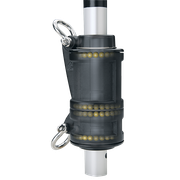
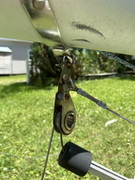
This Pic is a sleeve swivel thats glide,s over the foil on the top fitting u attach the Jib or Genny Halyard then attach the V glider into the foil pull the head of ur sail thru the V glider attach it to the bottom fitting pull ur jib halyard up & the sail self feeds into the foil slot thru the V glider as u raise the sail to the top of the furling foil then attach ur tack to the furler tack fitting & u r done no need to drop the mast with these type of furlers , u can raise or lower the sail just as u can a hanked sail !
Just so as U know
J
PS I have two of these furlers on my boat
Theirs absolutely no end to what u can do with an extra spare Halyard or two , I have 5 & counting
DaveC426913 wrote: ↑Wed Jun 08, 2022 10:34 am
That's the perfect job for the spare jib halyard: you lash it to the pulpit rail. Emergency averted.
(I'm actually going to set this up permanently.)
My jib halyard is LOWER than the forestay. So I can't use it like this. The roller furling jib would be tangled with it.
I added another mast hound ABOVE the forestay and ran a static line down to the pulpit as a backup in case the forestay gives out.
I'm rigging the boat for the first time and had the same question as the OP that motivated this thread. What does the jib halyard do on my 26M, and do I need it. It's comforting to have a question, come to this forum, and realize that you're not the first.
People seem to have come to different conclusions about whether it's needed or not, should stay or go. I was intrigued by the possibility of using it as a backup for the forestay, but that sounds like it's not possible. I'm trying to simplify my learning and I'm considering leaving off the jib halyard and removing the lazy jack for now as well.
If you have a "hank on sail" then you need a halyard to pull the sail up the forestay.
If you have a furling jib, then the only purpose I can see is for a Spinnaker.
As I do not own a Spinnaker, I removed mine so to have 1 less rope on the mast.
26X in Dallas Fort-Worth area Texas
Slip at Eagle Mountain Lake
Do you think I can use the jib halyard block to run a line to the bow as a backup? Or would the line be too close to the jib requiring another mast hound higher up?
Do you think I can use the jib halyard block to run a line to the bow as a backup? Or would the line be too close to the jib requiring another mast hound higher up?
I removed my jib halyard for reasons above. It's not being used and in the way.
I installed a second mast hound higher up as a "backup" forestay.
Yes, the stock jib halyard would get in the way.
I use it to put the sail cover on when I'm lowering the mast to protect it for storage or if I'm going to leave the boat for a month or longer. I would keep it for that reason at least.