Spent the fall and winter polishing things up, getting the motor running, and general repairs.
Wrestled with getting the title/registration papers right.
Floated and tested the motor.
Now I have the mast lifted for the first time and am working on running rigging. The boat was left out in the elements pretty much forever, so all lines are being replaced. (Standing rigging looks good.) Purchased a new main and 100% jib last week.
Since the jib is furling and it rigs (installs) with the mast, I plan to never actually hoist it. Can't think of an emergency situation where I'd actually need to pull it down. So why install a jib halyard and block at all?
Bonus question: In pulling off the furling genoa, I found that the top of the genoa was not secured; it seems to just float in the groove. There is a flat nylon line running up the spine of the grooved sail guide that is tied off to the roller mechanism and I believe terminates in a knot in the black top piece. What purpose does this serve? Is it a safety in case the steel cable breaks?
Without knowing more of your situation (RF UV cover, etc.) I strongly suggestyou do it. As you gain experience, you will be able to decide if your situation needs it.
Spent the fall and winter polishing things up, getting the motor running, and general repairs.
Wrestled with getting the title/registration papers right.
Floated and tested the motor.
Now I have the mast lifted for the first time and am working on running rigging. The boat was left out in the elements pretty much forever, so all lines are being replaced. (Standing rigging looks good.) Purchased a new main and 100% jib last week.
Since the jib is furling and it rigs (installs) with the mast, I plan to never actually hoist it. Can't think of an emergency situation where I'd actually need to pull it down. So why install a jib halyard and block at all?
Bonus question: In pulling off the furling genoa, I found that the top of the genoa was not secured; it seems to just float in the groove. There is a flat nylon line running up the spine of the grooved sail guide that is tied off to the roller mechanism and I believe terminates in a knot in the black top piece. What purpose does this serve? Is it a safety in case the steel cable breaks?
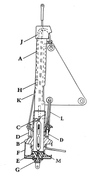
Based on this technical drawing of the CDI roller furler (courtesy BWY), it appears that the flattened line running up the spine (K in diagram) is a jib halyard... which makes sense in hindsight, since a jib halyard fixed to the mast would get all wound up when the jib is furled. This makes the standard jib halyard both redundant and useless for hosing any furling sail.
Does anyone else find the jib downhaul (L) a bit hokey? Have to replace my weathered line. Seems awfully weird to secure the jib tack with 8 passes of a glorified shoelace.
Last edited by Piddle and Futz on Mon Jun 06, 2022 2:03 pm, edited 2 times in total.
Interesting question. I use my jib halyard to step the mast on my "X", so it does have a purpose for me. I understand the "M's" mast stepping system does not, although to be candid, I have never paid much attention to that system. Except for its mast raising duties, my jib halyard just sits there cleated down day in and day out. Like you I have roller furling for my jib. Nonetheless, I like having the jib halyard there. I keep threatening to actually use it to hoist my spinnaker, but I never have tried it. Its on my bucket list, but we'll see. I, also, fantasize about needing it as a jury rigged forestay in some unforeseen calamity. Lastly, as my fellow forum folks know, I am a strong believer in redundancy in control systems, and having some piece of equipment available when a use is suddenly discovered and thrust upon you is generally better than not having it and wishing suddenly that you did. Oh, just popped into my head---toping lift for a whisker pole. Or a halyard for pennants or LED light strings to mark holiday events, or to hold up the middle of a tarp or windsail over the forward hatch. https://www.westmarine.com/buy/west-mar ... il--357956
Thanks for the mental exercise. enjoyed thinking about it. Cheers.
Piddle and Futz wrote: ↑Mon Jun 06, 2022 9:30 am
Based on this technical drawing of the CDI roller furler (courtesy BWY), it appears that the flattened line running up the spine (K in diagram) is a jib halyard...
There's only a couple feet of tail on K wrapped around the furler mechanism. It would need to be 2x the length of the forestay in order to hoist a jib with it. If I had to guess, I imagine that the little metal part part (H) stays stays captive in the guide slot, and one is meant to tie another line temporarily to K, pull the internal jib halyard to the bottom (bringing H to the top of the guide slot), slot the jib into the guide, and hoist it using the extra temporary line.
Makes me wonder if any other Mac owners with self-furling jibs/genoas have ever used this mechanism to hoist the jib... or if they just keep it installed the way it came.
I removed mine.
The only use I had for it was to pull my jib sock up.
I use my main halyard for that now and I have a mast raising system.
If you have an emergency and need to lower your mast, you have your main halyard.
26X in Dallas Fort-Worth area Texas
Slip at Eagle Mountain Lake
I use mine for that and for my BWY asymmetrical spinnaker - a lot of fun downwind
leefrankpierce wrote: ↑Tue Jun 07, 2022 6:24 am
I removed mine.
The only use I had for it was to pull my jib sock up.
I use my main halyard for that now and I have a mast raising system.
If you have an emergency and need to lower your mast, you have your main halyard.
What is a "mast-lowering emergency"
Don't know, the OP brought it up.
I guess if your forestay looks like it is about to give up?
Or you are heading for a bridge that will hit the mast?
I can say that when I was doing preventative maint and replaced my forestay, I found my old one had half the strands broken and wrapped up inside the furler. That was scary to find.
Suggest everyone take their mast down once and a while, pull the furler, and check the forestay.
26X in Dallas Fort-Worth area Texas
Slip at Eagle Mountain Lake
Piddle and Futz wrote: ↑Mon Jun 06, 2022 9:18 am
Since the jib is furling and it rigs (installs) with the mast, I plan to never actually hoist it. Can't think of an emergency situation where I'd actually need to pull it down. So why install a jib halyard and block at all?
Looks like the OP was referring to an emergency where the jib needed to come down (presumably due to some issue with the Furler.
With the cheap small Furlers we generally have, using the de-cored slot-fed jib/Genoa halyard to lower the sail; seems impractical. I would (and have) hand furl the sail before I tried to drop it with the halyard.
If you have a good quality Furler with a top bearing and external halyard, then lowering the sail becomes a better option.
Reading back, I didn't see a reference to emergency mast lowering, but maybe I missed it.
Jimmyt
P-Cub-Boo
2013 26M, Etec 60, roller Genoa, roller main
Cruising Waters: Mobile Bay, Western Shore, Fowl River
leefrankpierce wrote: ↑Tue Jun 07, 2022 9:33 pm
What is a "mast-lowering emergency"
Don't know, the OP brought it up.
I guess if your forestay looks like it is about to give up?
Or you are heading for a bridge that will hit the mast?
Certainly, these two would constitute a mast-lowering emergency...
While recovering from surgery, I've wandered, on more than one occasion, down the boating fails videos rabbit hole. The number of sailboats that go under bridges with insufficient clearance (or get swept under them in current), is staggering. Always makes my skin crawl, but I can't look away...
Jimmyt
P-Cub-Boo
2013 26M, Etec 60, roller Genoa, roller main
Cruising Waters: Mobile Bay, Western Shore, Fowl River