

Getting ready for Spring! Yippie!

Part of that is going through all the annual paperwork as well as making preparations for the physical stuff to be done ( once it warms up enough to feel my fingers without artic mittens..
)One item that came up was when we were recently made aware of new fire extinguisher requirements that go into effect in April 2022.
It seems that our two existing extinguishers are right at the edge of those requirements this year. So we’re going ahead and upgrading to the new regulations with a pair of new 10 lb ABC Class units.
BoatUS: New U.S. Coast Guard Fire Extinguisher Regulation Effective April 20
12 year expiration for disposables and different carriage requirements for older, newer model
https://www.boatus.com/news-room/releas ... nguisher-r
That’s because a new U.S. Coast Guard regulation beginning April 20 for disposable fire extinguishers mandates a 12-year expiration date from the date of manufacture. Boaters can find the manufacture date stamped into the bottom of the bottle or near the UL label. This may be two or four digits — if it is two, as in 08, that means 2008. Additionally, while the new regulation does not change the type (U.S. Coast Guard-rated) or quantity or requirement for USCG approved fire extinguishers aboard, it does specify the minimum Underwriter Laboratory (UL) classification of extinguishers to be carried aboard certain vessels — depending on the boat’s model year.
This is the result of phasing out older “B-I” and “B-II” labels for newer “5-B” “10-B” and “20-B” extinguisher classifications. The number in this new rating refers to the size in square feet of the potential fire the device is suitable to extinguish and not the exact weight of the dry chemical inside the bottle.
Any time I’ve replaced expiring fire extinguishers I’ve taken it as an opportunity to have family and friends practice the safe and proper operation of an extinguisher in a safe controlled environment. (Especially if I can get one of our local Fire Department personnel involved. This time we are going to try and get our USCG and or local Maritime Fire personnel involved.) It’s a great opportunity to make sure they are prepared, knowing what to expect and what the extinguishers capabilities are well before there is a crisis.For boats 26 feet or greater, however, having one “10-B” aboard does not equal two 5-Bs. Only a “20-B” classification meets the requirement to carry two “5-B” extinguishers. For a look at how many and what type of fire extinguishers are needed aboard all recreational boats up to 65 feet, go to BoatUS.org/Fire-Extinguishers.
BoatUS strongly recommends going beyond the regulation’s minimum requirements. The results from a Foundation-sponsored boat burn showed that one extinguisher may give very little time to make an emergency call or potentially prepare to abandon your vessel.
BoatUS also notes that most U.S. Coast Guard disposables on the market today carry at least a dual B:C rating, able to douse both liquids and electrical fires, and some boat owners wisely prefer triple rated A:B:C extinguishers, adding a third protection for combustible fires.
To be serviceable, a portable extinguisher must have a pressure gauge indicating an operable range, lock pin firmly installed, clean discharge nozzle, and no significant corrosion or damage. Some more recently manufactured portable fire extinguishers aboard boats today may carry both old and new labeling, for example, having simultaneous “B-I” and “5-B” classifications.
Part of this is finding new mounting locations for the new 10 lb extinguishers…. It would be nice to know of where others on the forum have found to mount theirs. Any ideas/examples?
Best Regards
Over Easy


 So that didn’t work….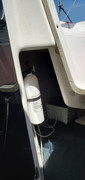
 ).
).