This is very similar to my approach. Eliminate threaded fasteners, and don't remove anything that you can secure.Starscream wrote: ↑Thu Oct 14, 2021 8:11 am To hit my 30-minute launch challenge:
1) Sidestays, backstay, and spreaders stay fully attached. The lifelines have quick-disconnect pelican hooks so that the spreaders aren't resting on them during transport.
2) No nuts and bolts. All of the 9/16 bolts and nuts have been replaced with these: https://shop.bwyachts.com/product-p/3443-1v0.htm
3) All 7/16 bolts (rudders, spreaders, boom attachment) have been replaced with trailer coupler pins like these: https://www.amazon.ca/Safety-Coupler-Ma ... 808&sr=8-5
4) Loose footed main (huge time savings in setup) with sail slugs, of course.
5) Added a second forestay above the roller furler, with a turnbuckle and a snap-shackle. Very easy to snap it on, tighten the turnbuckle to pin the furler pin, then back it off again. Plus, the added safety is nice.
6) Snap shackles to attach mainsheet and boom vang.
7) Snap-hook on the boom to attach the mainsail tack-ring with a click.
Mainsail outhaul run through a quick-release cleat
9) Topping lift with two snap-hooks: one to keep the lift attached while sailing with no tension, the other a bit higher up to hold the boom above the dodger when the sail is down.
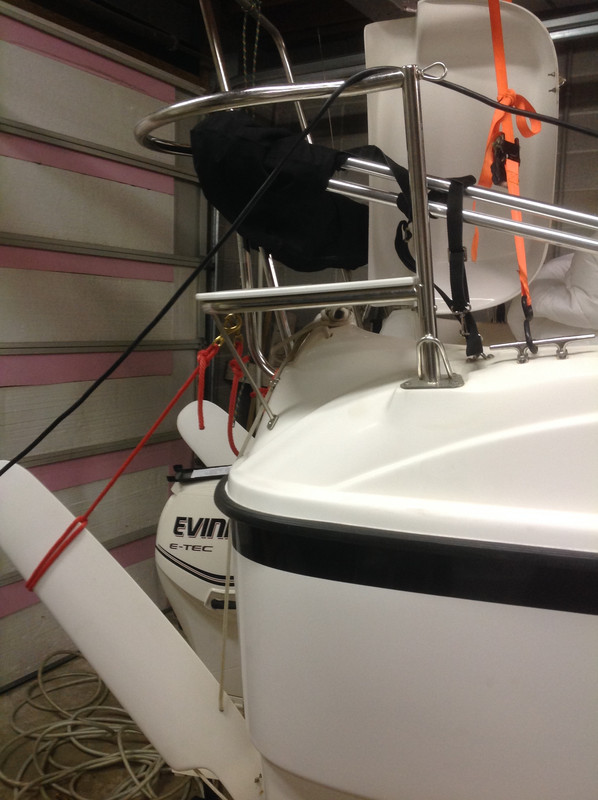
The biggest single time saver is to invest a few seconds to check the standing rigging attachment points for snags, and place the stays in the right place vis a vis the stantions and other snag points. You'll start to know what they are after a few trys. The backstay snags the motor with startling accuracy, the sidestays snag the trailer posts and the stantions. The worst time waster is getting the mast up with a snag at height, the second worst is a snag that is out of reach during the lifting process (no MRS here, yet).
Starscream's point about making sure nothing is tangled/snagged is solid gold. Nothing increases setup time like having to drop the rig you just raised to untangle something.
Excellent!


 owners, they can do what you can't, rig you boat in a half hour easily. The mast on the
  , and you do need the mast raising system for the
  .
.