

I have a very cantankerous little engine driven dc charger which uses a car alternator. I bought it from an outfit in England. I’ve also made my own, which might not be much better. Now I need some help fooling the alternator to make it charge at full capacity as the battery voltage comes up. I’m using a 20 amp tractor alternator. My prototype will put out about that if I charge a battery with an inverter hooked to it, operating a load like a jitterbug sander. But output tapers off quickly to 8-10 amps otherwise. 10 amps is certainly enough to charge the battery enough to start the engine, but it’s not as efficient use of the system to charge batteries on a nasty rainy day when you want to watch movies all day.
Thanks!
Ix
Assistance with home made bush charger
-
Russ

- Admiral
- Posts: 8312
- Joined: Thu Oct 11, 2007 12:01 pm
- Sailboat: MacGregor 26M
- Location: Bozeman, Montana "Luna Azul" 2008 M 70hp Suzi
Re: Assistance with home made bush charger
Interesting topic. I know next to nothing other than there seems to be some marine voltage regulators designed for this purpose. We've got some great engineers on this forum that hopefully can chime in.
Maybe you can glean some info from Sumner's 12v generator build.
http://purplesagetradingpost.com/sumner ... de-13.html
Maybe you can glean some info from Sumner's 12v generator build.
http://purplesagetradingpost.com/sumner ... de-13.html
--Russ
-
Inquisitor

- Captain
- Posts: 926
- Joined: Mon Apr 23, 2007 5:24 pm
- Sailboat: MacGregor 26M
- Location: North Carolina Mountains
Re: Assistance with home made bush charger
I too want to hear what experts have to say and will be watching your thread.
In the mean time, I'll put in my amateur, 2 cents. A few things I've picked up from my microelectronics hobby and here on the forum:
In the mean time, I'll put in my amateur, 2 cents. A few things I've picked up from my microelectronics hobby and here on the forum:
- That lead-acid chemistry resistance goes up as it nears its max capacity.
- Because of Ohm's law, the current drops. This would suggest upping the voltage would increase the current...
- So... doesn't running an car alternator faster cause it to put out higher voltage? - Maybe, use different diameter pulleys.
- But... doesn't high voltage into lead acid (un-monitored) cause explosive potential off-gassing?
- Since you know my bag is toward Lithium batteries, I'll bring up: LiFePO4 batteries won't have this problem... they will absorb full tilt till they're full. In fact, they have the opposite problem... they tend to burn out the alternator because they are drawing too much current. Either you have to use an industrial strength alternator that can run at 100% duty cycle OR you have to use electronics to regulate how much current is drawn out based on a heat sensor on the alternator.
Odysseus, expert on the Siren's call
-
Ixneigh

- Admiral
- Posts: 2469
- Joined: Thu Sep 09, 2010 11:00 am
- Sailboat: MacGregor 26M
- Location: Key largo Florida
Re: Assistance with home made bush charger
Hmmm. Sumner is quite the machinist. My set up is a lot simpler and can be made by someone with basic hand tools. Its intended to fit under the dinette on the M model.
Neither he, nor the links he provided in his webpage, mentioned how to wire the alternator so it doesn’t taper off the charge though. But thank you for posting those.
Ix
Neither he, nor the links he provided in his webpage, mentioned how to wire the alternator so it doesn’t taper off the charge though. But thank you for posting those.
Ix
"Shoal Idea"
2011 M, white
Tohatsu 20
South Fl.
2011 M, white
Tohatsu 20
South Fl.
-
OverEasy
- Admiral
- Posts: 2895
- Joined: Mon Sep 28, 2020 11:16 am
- Sailboat: MacGregor 26X
- Location: NH & SC
Re: Assistance with home made bush charger
We believe that Inquisitor is on the right tack with battery chemistry and avoidance of battery Over heating.
There is probably a voltage/current regulator limiting the output.

There is probably a voltage/current regulator limiting the output.
-
Be Free

- Admiral
- Posts: 1895
- Joined: Fri Nov 23, 2012 6:08 pm
- Sailboat: MacGregor 26X
- Location: Steinhatchee, FL
Re: Assistance with home made bush charger
Automotive (and I'm sure tractor) alternators will either have an internal or external voltage regulator. No matter how fast you run them the regulator will not allow the voltage to go over the set point. In the old days (when I was young) this was a mechanical device that could be adjusted. I expect that modern alternators are doing this electronically. Of course it is quite possible that a tractor alternator might still use an external mechanical regulator. The only danger I see in your setup is if the alternator is supposed to have an external regulator and you don't have one installed. In that case you could exceed the voltage to the battery where you could begin to boil off electrolyte.
Bill
2001 26X Simple Interest
Honda BF40D
"If I were in a hurry I would not have bought a sailboat." Me
2001 26X Simple Interest
Honda BF40D
"If I were in a hurry I would not have bought a sailboat." Me
-
Ixneigh
- Admiral
- Posts: 2469
- Joined: Thu Sep 09, 2010 11:00 am
- Sailboat: MacGregor 26M
- Location: Key largo Florida
Re: Assistance with home made bush charger
It does have in internal regulator. It charges at 14 v as shown by the voltage indicator. Interestingly it charges with only the two red and black wires connected. The others don’t seem to be needed.Be Free wrote: ↑Fri Apr 23, 2021 12:19 pm Automotive (and I'm sure tractor) alternators will either have an internal or external voltage regulator. No matter how fast you run them the regulator will not allow the voltage to go over the set point. In the old days (when I was young) this was a mechanical device that could be adjusted. I expect that modern alternators are doing this electronically. Of course it is quite possible that a tractor alternator might still use an external mechanical regulator. The only danger I see in your setup is if the alternator is supposed to have an external regulator and you don't have one installed. In that case you could exceed the voltage to the battery where you could begin to boil off electrolyte.
"Shoal Idea"
2011 M, white
Tohatsu 20
South Fl.
2011 M, white
Tohatsu 20
South Fl.
-
Ixneigh
- Admiral
- Posts: 2469
- Joined: Thu Sep 09, 2010 11:00 am
- Sailboat: MacGregor 26M
- Location: Key largo Florida
Re: Assistance with home made bush charger
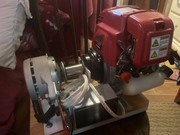
This is a four stroke weed eater motor with a clutch. The clutch allows the switch to be omitted. Connect the leads, note battery voltage, start engine, apply throttle until clutch engages. Then after a bit you could throttle back a bit but it does like to run at high rpm. It will put out twenty amps without much issue. I was going to try to make these to sell, but one really needs a shop for that. The nearest available equivalent weighs ten pound more and costs 850 dollars. Some of these were made in the fifties through seventies though.
Ix
Ix
"Shoal Idea"
2011 M, white
Tohatsu 20
South Fl.
2011 M, white
Tohatsu 20
South Fl.
-
Inquisitor
- Captain
- Posts: 926
- Joined: Mon Apr 23, 2007 5:24 pm
- Sailboat: MacGregor 26M
- Location: North Carolina Mountains
Re: Assistance with home made bush charger
That is pretty cool!Ixneigh wrote: ↑Sat Apr 24, 2021 8:54 am This is a four stroke weed eater motor with a clutch. The clutch allows the switch to be omitted. Connect the leads, note battery voltage, start engine, apply throttle until clutch engages. Then after a bit you could throttle back a bit but it does like to run at high rpm. It will put out twenty amps without much issue. I was going to try to make these to sell, but one really needs a shop for that. The nearest available equivalent weighs ten pound more and costs 850 dollars. Some of these were made in the fifties through seventies though.
Ix
Yours ought to be lighter and more efficient... 5hp Honda is way overkill. I'd bet just about any size car/truck/tractor alternator doesn't require 5hp. Besides yours being direct drive has no pulley/belt losses. Hmmm... 272 Ah / 20 amps = ~ 14 hours... Got any leads on a larger alternator?

Odysseus, expert on the Siren's call
-
OverEasy
- Admiral
- Posts: 2895
- Joined: Mon Sep 28, 2020 11:16 am
- Sailboat: MacGregor 26X
- Location: NH & SC
Re: Assistance with home made bush charger
The engine hp and alternator size are a good load match engineering wise as made.
One doesn’t want to run at peak rated hp anyway.
Very nice!
There are still a couple of DC power chargers still on the market but only a fraction of what used to be in the pre 70s eras when most people were happy to have 12 volt lighting in the wilds.... Now AC generation has all the consumer demand but that is slowly changing yet again with van conversion campers getting high efficiency 12VDC refrigerators/freezers, battery operated tools, DC phone and computer charging freeing them from the AC requirement.
Alternators are more functionally efficient than Generators pound-for-pound and tended to outlast them given permanent magnet degradation. The newer magnetic materials have yet to match the consistency/durability of alternator field coil strength to weight.
One doesn’t want to run at peak rated hp anyway.
Very nice!
There are still a couple of DC power chargers still on the market but only a fraction of what used to be in the pre 70s eras when most people were happy to have 12 volt lighting in the wilds.... Now AC generation has all the consumer demand but that is slowly changing yet again with van conversion campers getting high efficiency 12VDC refrigerators/freezers, battery operated tools, DC phone and computer charging freeing them from the AC requirement.
Alternators are more functionally efficient than Generators pound-for-pound and tended to outlast them given permanent magnet degradation. The newer magnetic materials have yet to match the consistency/durability of alternator field coil strength to weight.
-
Ixneigh
- Admiral
- Posts: 2469
- Joined: Thu Sep 09, 2010 11:00 am
- Sailboat: MacGregor 26M
- Location: Key largo Florida
Re: Assistance with home made bush charger
I was kind of hoping the Chinese would make a really nice compact one  but I had to. Even the oldies are selling for a premium on eBay.
Ix
 but I had to. Even the oldies are selling for a premium on eBay.
 Ix
"Shoal Idea"
2011 M, white
Tohatsu 20
South Fl.
2011 M, white
Tohatsu 20
South Fl.
-
bubby-joe
- Deckhand
- Posts: 35
- Joined: Wed Oct 21, 2020 4:58 pm
- Sailboat: MacGregor 26S
- Location: Kitimat
Re: Assistance with home made bush charger
One thing that's different with a marine alternator's is most are self exciting, that means to get it to charge you have to rev whatever is turning the alternator to around 1800 RPM to get them to start charging then they use an internal regulator to control charging. If you don't excite it does nothing till you do.
Auto alternators should put out 14.5 to 14.8 volt right after startup and then regulate the input to not overheat the battery, these also usually turn faster than marine units
.
Marine units should put out 13.8 volt after exciting the field windings to get it to start charging most don't go over this and take longer to bring the battery to a full charge.
I might also suggest an 18 volt solar charger just to maintain the full charge, these however will charge at a lower rate when cloudy, my unit puts out 15.2 volt in full sun and around 13.5 to 14.8 on a normal day with very slight and thin wispy cloud or haze but on a 24 hour period it works out to never have to charge my sounder battery pack put on any other charger.
Hope some of this helps
Auto alternators should put out 14.5 to 14.8 volt right after startup and then regulate the input to not overheat the battery, these also usually turn faster than marine units
.
Marine units should put out 13.8 volt after exciting the field windings to get it to start charging most don't go over this and take longer to bring the battery to a full charge.
I might also suggest an 18 volt solar charger just to maintain the full charge, these however will charge at a lower rate when cloudy, my unit puts out 15.2 volt in full sun and around 13.5 to 14.8 on a normal day with very slight and thin wispy cloud or haze but on a 24 hour period it works out to never have to charge my sounder battery pack put on any other charger.
Hope some of this helps
-
Be Free
- Admiral
- Posts: 1895
- Joined: Fri Nov 23, 2012 6:08 pm
- Sailboat: MacGregor 26X
- Location: Steinhatchee, FL
Re: Assistance with home made bush charger
I'm assuming we are talking about a 12V flooded lead acid battery here. If you have something else the numbers will be different.Ixneigh wrote: ↑Sat Apr 24, 2021 8:47 amIt does have in internal regulator. It charges at 14 v as shown by the voltage indicator. Interestingly it charges with only the two red and black wires connected. The others don’t seem to be needed.Be Free wrote: ↑Fri Apr 23, 2021 12:19 pm Automotive (and I'm sure tractor) alternators will either have an internal or external voltage regulator. No matter how fast you run them the regulator will not allow the voltage to go over the set point. In the old days (when I was young) this was a mechanical device that could be adjusted. I expect that modern alternators are doing this electronically. Of course it is quite possible that a tractor alternator might still use an external mechanical regulator. The only danger I see in your setup is if the alternator is supposed to have an external regulator and you don't have one installed. In that case you could exceed the voltage to the battery where you could begin to boil off electrolyte.
The majority of your charging will take place during the bulk phase. The amperage (current) is held constant and the voltage is high. This is usually around 14.8V. You will get 80-90% of your charge here.
Next comes absorption phase. The voltage is held constant and the amperage will slowly decrease as the battery finishes charging. The voltage here is around 14.2V. This brings your battery up to 100% charge.
Finally you will go into the float phase. Voltage is around 13.6V and amperage will be quite low. This is for maintaining the charged battery and is sometimes called a trickle charge.
It should be noted that only in the bulk phase is the charger limiting the current it will allow the battery to draw. In all other phases the battery will control the current flowing into it based on the supplied voltage and the internal resistance (which changes as the battery is charged).
If your alternator is regulated at 14V you are going to charge a little differently. Based on your original post there does not seem to be anything limiting the current the alternator will provide other than it's own maximum output. You are going to be between absorption and float all of the time. It's not optimal for maximum battery life but as long as you are not discharging the batteries too deeply you won't be hurting them significantly.
If you plan on using this setup to keep your start battery charged it should work fine. If you are planning on using it for a house bank that will be discharged deeper it will take a longer to charge than something that uses all three charge phases and it will be more prone to sulfation.
In your first post you said if you put a load on it you saw 20A but without the additional load it quickly dropped to 8-10A. This is perfectly normal. The amperage that the battery will draw will be based on the internal resistance of the battery. The internal resistance of the battery will increase as the battery is charged. In the first case the battery was drawing 8-10A and the inverter was drawing 10-12A giving you the 20A reading. When you removed the inverter all you saw was the battery.
Unless you have a 400AH battery that is more than around 20% discharged your battery is not going to need 20A to charge. I suspect that if you let it run a little longer the current will drop down below 5A fairly quickly (assuming you are charging a start battery). If you are testing with a 200AH or so deep cycle battery 10A is about right.
Bill
2001 26X Simple Interest
Honda BF40D
"If I were in a hurry I would not have bought a sailboat." Me
2001 26X Simple Interest
Honda BF40D
"If I were in a hurry I would not have bought a sailboat." Me
-
Ixneigh
- Admiral
- Posts: 2469
- Joined: Thu Sep 09, 2010 11:00 am
- Sailboat: MacGregor 26M
- Location: Key largo Florida
Re: Assistance with home made bush charger
Bill. Thank you for that detail post.
When I bought the original one from jolly old England, they promised fifty amp charging until the battery was full. It did put out a lot of power but I only ever ran it an hour at a time. (As cautioned in the manual) In short order the the negative lug inside the plastic electrics housing melted the plastic and formed a very hard to find electric fault. At first I thought it was the alternator and replaced that. Once I located the real problem and fixed it, the output was only in the 10-15 range (tested) and it was obvious it was not loading the engine as much as the first time. After nearly endless little issues with the unit I decided to make my own. Which also only put out ten amps. But it’s lighter and simpler. What were the original engineers in england doing that I’m not, or did they have a special alternator to use? It looked like a regular one to me but sadly I’ve misplaced it. (I think I had to provide a core to get the new alternator. (I probably should have tested that unit but had no way too. It smelled like it got pretty hot though.)
Ix
When I bought the original one from jolly old England, they promised fifty amp charging until the battery was full. It did put out a lot of power but I only ever ran it an hour at a time. (As cautioned in the manual) In short order the the negative lug inside the plastic electrics housing melted the plastic and formed a very hard to find electric fault. At first I thought it was the alternator and replaced that. Once I located the real problem and fixed it, the output was only in the 10-15 range (tested) and it was obvious it was not loading the engine as much as the first time. After nearly endless little issues with the unit I decided to make my own. Which also only put out ten amps. But it’s lighter and simpler. What were the original engineers in england doing that I’m not, or did they have a special alternator to use? It looked like a regular one to me but sadly I’ve misplaced it. (I think I had to provide a core to get the new alternator. (I probably should have tested that unit but had no way too. It smelled like it got pretty hot though.)
Ix
"Shoal Idea"
2011 M, white
Tohatsu 20
South Fl.
2011 M, white
Tohatsu 20
South Fl.
-
Ixneigh
- Admiral
- Posts: 2469
- Joined: Thu Sep 09, 2010 11:00 am
- Sailboat: MacGregor 26M
- Location: Key largo Florida
Re: Assistance with home made bush charger
I have 200 watts of solar but after a cloudy day I use the generator since I have the cold box running. My charge regulator monitors the voltage and controls that. I don’t know if my solar 18 volts specifically but I know it’s more than 12.bubby-joe wrote: ↑Sat Apr 24, 2021 5:51 pm One thing that's different with a marine alternator's is most are self exciting, that means to get it to charge you have to rev whatever is turning the alternator to around 1800 RPM to get them to start charging then they use an internal regulator to control charging. If you don't excite it does nothing till you do.
Auto alternators should put out 14.5 to 14.8 volt right after startup and then regulate the input to not overheat the battery, these also usually turn faster than marine units
.
Marine units should put out 13.8 volt after exciting the field windings to get it to start charging most don't go over this and take longer to bring the battery to a full charge.
I might also suggest an 18 volt solar charger just to maintain the full charge, these however will charge at a lower rate when cloudy, my unit puts out 15.2 volt in full sun and around 13.5 to 14.8 on a normal day with very slight and thin wispy cloud or haze but on a 24 hour period it works out to never have to charge my sounder battery pack put on any other charger.
Hope some of this helps
"Shoal Idea"
2011 M, white
Tohatsu 20
South Fl.
2011 M, white
Tohatsu 20
South Fl.