Need Purchasing Advice 26X
-
Rumdirty

- Engineer
- Posts: 123
- Joined: Thu Mar 19, 2015 7:56 am
- Sailboat: MacGregor 26M
- Location: Mount Holly, NJ. 2005 26M, Honda BF50
- Contact:
Re: Need Purchasing Advice 26X
Ditto on replacing water pump / impeller. Just bought a 10 year old Mac. One of the top items on the Surveyor's list was to change out the impeller. Could save you from a multi thousand dollar problem down the road. Didn't matter that the motor ran great, he said just do it. On a good note, it's an easy job. Definently one to do yourself.
-
mastreb

- Admiral
- Posts: 3927
- Joined: Wed Feb 09, 2011 9:00 am
- Sailboat: MacGregor 26M
- Location: Cardiff by the Sea, CA ETEC-60 "Luna Sea"
- Contact:
Re: Need Purchasing Advice 26X
One point: The right speed to be going while docking is between 2 and 3 knots. Below 2 knots, there's not enough water flow to keep the boat from just doing what it wants. Above 3 knots, you might break something. Going too slow is not as bad as going too fast, but it's still bad.
Get used to stopping the boat with a shot of reverse so you're not worried about hitting things. And all boards down below 6 knots.
Get used to stopping the boat with a shot of reverse so you're not worried about hitting things. And all boards down below 6 knots.
-
March

- Captain
- Posts: 970
- Joined: Wed May 24, 2006 7:54 am
- Sailboat: MacGregor 26X
- Location: Iowa, MacGregor 26X, Yamaha 4 stroke 50 HP
Re: Need Purchasing Advice 26X
All broads down below, at 6 knots, too.masterb wrote:
And all boards down below 6 knots.
-
mallardjusted

- First Officer
- Posts: 200
- Joined: Fri Oct 21, 2005 5:33 pm
- Sailboat: MacGregor 26X
- Location: Puget Sound, 2001 Sold Oct2021 "Aqua Dawg", 70hp Yam
Re: Need Purchasing Advice 26X
I've had a Suzuki 50 on my 2002 X, owning it since 2006. I traded it in for a new Yamaha 70 a year ago, and one of the nice side benefits is it swings a bigger prop. This makes for a noticeable improvement in slow-speed handling.
-
Russ

- Admiral
- Posts: 8402
- Joined: Thu Oct 11, 2007 12:01 pm
- Sailboat: MacGregor 26M
- Location: Bozeman, Montana "Luna Azul" 2008 M 70hp Suzi
Re: Need Purchasing Advice 26X
Agreed. Although it's not that easy on my Suzuki, but MUCH easier on land than in the water. Lots of Youtube videos how to.Rumdirty wrote:Ditto on replacing water pump / impeller. Just bought a 10 year old Mac. One of the top items on the Surveyor's list was to change out the impeller. Could save you from a multi thousand dollar problem down the road. Didn't matter that the motor ran great, he said just do it. On a good note, it's an easy job. Definently one to do yourself.
If you don't know the history, spend $20 bucks and replace it.
-
C Buchs
- Captain
- Posts: 605
- Joined: Thu Apr 23, 2015 6:49 pm
- Sailboat: MacGregor 26X
- Location: Camas, WA 98607
Re: Need Purchasing Advice 26X
I've gotten the boat in and out of the marina 4 times now without another incident. I'm getting more confident every time. I'm finally able to use the current that is 1-2 knots. I find it easier to use the current going over the rudders to steer than the thrust of the outboard. I was too worried about getting the mast up without problems and didn't have a plan. After a few days of thinking about what went wrong, I've figured out something that works. First was making sure I have ballast in. The boat changes direction slower when it's heavier. Second was to keep the boat pointed up river. Then I can slowly move sideways using the current on the rudders and giving the boat a little push with the outboard when I drift too far back. The more confident I get, the faster I'm moving sideways down the row to my slip. 
I was having some trouble with the outboard misfiring this weekend. I changed the fuel, fuel filter, and spark plugs before it smoothed out. I'll order a water pump. I was told that for a 2000 Honda 50, I have to order the housing and impeller. Apparently about $100. You guys had a great thread recently about what web sites to buy parts from. I'll reference it when I get time to start looking. Just another example of how you guys help!!
Jeff
I was having some trouble with the outboard misfiring this weekend. I changed the fuel, fuel filter, and spark plugs before it smoothed out. I'll order a water pump. I was told that for a 2000 Honda 50, I have to order the housing and impeller. Apparently about $100. You guys had a great thread recently about what web sites to buy parts from. I'll reference it when I get time to start looking. Just another example of how you guys help!!
Jeff
-
mastreb
- Admiral
- Posts: 3927
- Joined: Wed Feb 09, 2011 9:00 am
- Sailboat: MacGregor 26M
- Location: Cardiff by the Sea, CA ETEC-60 "Luna Sea"
- Contact:
Re: Need Purchasing Advice 26X
Don't underestimate the value of practice. I had a lot of trouble initially with the high windage of the MacGregor (partly caused by attempting to use the worst launch ramp on the west coast) and docking, until I spent an entire day just coming and going.
With family commitments, it's easy to schedule a day and want to get the most out of it which means getting straight out to the water, but this leaves you will precious little experience in basic maneuvering. Here are the things I've spent specific time on my own practicing:
1) Docking and precision low-speed maneuvers (boards up, down, daggerboard in intermediate positions, motoring against a dock line, etc.
2) Anchoring
3) Reefing and dropping sail.
The reason is that those are things you (a) can never be too good at and (b) really matter in an emergency.
Many people forget in a blow or waves when they've lost control and their engine won't start that they have an anchor they can use to keep from being blown ashore. They forget because they rarely anchor or only anchor in specific circumstances.
Reefing quickly is a very important skill to have. I sail right past boats here in San Diego Bay that are heeled over on their ears with all their sail out when I'm already double reefed--and going faster than they are. Reefing takes all the angst out of sailing for passengers as well and makes even strong winds seem like just a blustery day, rather than a hurricane force gale. And dropping sail quickly can keep you from being blown ashore if you've lost headway, although in these light boats you will still have to counter the windage of the hull.
Skill in docking is also quite critical. Put a 50' line on both sides of the boat which will allow a single person to control the boat fore and aft at the dock. I put an extra cleat on the aft stop of the gunnel tracks to cleat it tight and keep it from hanging overboard, with the slack in the cockpit. Learn to spring off of dockline fixed to a stern cleat as the boat backs--once the slack is taken out, the boat will rotate immediately to the opposite side of the dockline. Release the dockline and haul it aboard. You can then forward down the fairway without worrying about hitting anyone even in tight quarters. Learn to dock both bow-in and stern-in so you can choose the appropriate method for each situation. Learn to rotate the boat on its daggerboard/centerboard with the engine without moving forward or aft. This skill is critical for tight quarters docking, but very few people in my marina seem to know how to do it. Learn how to dock in high winds, which in this boat means coming into the side the winds demand you come into, and then using dock-lines to pull the boat to its final location from the dock. Sometimes this requires making sudden friends with a slip-mate to explain the boot prints on their gunnels.
Schedule some time to practice, or you'll never really get good at it.
With family commitments, it's easy to schedule a day and want to get the most out of it which means getting straight out to the water, but this leaves you will precious little experience in basic maneuvering. Here are the things I've spent specific time on my own practicing:
1) Docking and precision low-speed maneuvers (boards up, down, daggerboard in intermediate positions, motoring against a dock line, etc.
2) Anchoring
3) Reefing and dropping sail.
The reason is that those are things you (a) can never be too good at and (b) really matter in an emergency.
Many people forget in a blow or waves when they've lost control and their engine won't start that they have an anchor they can use to keep from being blown ashore. They forget because they rarely anchor or only anchor in specific circumstances.
Reefing quickly is a very important skill to have. I sail right past boats here in San Diego Bay that are heeled over on their ears with all their sail out when I'm already double reefed--and going faster than they are. Reefing takes all the angst out of sailing for passengers as well and makes even strong winds seem like just a blustery day, rather than a hurricane force gale. And dropping sail quickly can keep you from being blown ashore if you've lost headway, although in these light boats you will still have to counter the windage of the hull.
Skill in docking is also quite critical. Put a 50' line on both sides of the boat which will allow a single person to control the boat fore and aft at the dock. I put an extra cleat on the aft stop of the gunnel tracks to cleat it tight and keep it from hanging overboard, with the slack in the cockpit. Learn to spring off of dockline fixed to a stern cleat as the boat backs--once the slack is taken out, the boat will rotate immediately to the opposite side of the dockline. Release the dockline and haul it aboard. You can then forward down the fairway without worrying about hitting anyone even in tight quarters. Learn to dock both bow-in and stern-in so you can choose the appropriate method for each situation. Learn to rotate the boat on its daggerboard/centerboard with the engine without moving forward or aft. This skill is critical for tight quarters docking, but very few people in my marina seem to know how to do it. Learn how to dock in high winds, which in this boat means coming into the side the winds demand you come into, and then using dock-lines to pull the boat to its final location from the dock. Sometimes this requires making sudden friends with a slip-mate to explain the boot prints on their gunnels.
Schedule some time to practice, or you'll never really get good at it.
-
yukonbob

- Admiral
- Posts: 1918
- Joined: Mon Feb 14, 2011 6:54 pm
- Sailboat: Other
- Location: Whitehorse Yukon
Re: Need Purchasing Advice 26X
I never keep a dock line at the bow that can reach the prop, just saying. Also pick a docking helper that will be with you most of the time. My buddies always want to help out and help me dock in place of the admiral. They always get pi$$ when I tell them no and that she can handle herself just fine. She does it all the time and she knows what to do, when to do it as well what to do if things go sideways. I’ve had people ‘helping’ hop off and just stand there, not even holding a dock line. Others just stand there with the line in hand looking at other boats or the sky, anything but what the boat is doing; or they’re over ambitious and tie the bow tight to the dock and stand there like it’s all done and they’ve saved the day then wonder why I’m not bringing the stern in. 

Re: Need Purchasing Advice 26X
Congrats on the newI was having some trouble with the outboard misfiring this weekend. I changed the fuel, fuel filter, and spark plugs before it smoothed out. I'll order a water pump. I was told that for a 2000 Honda 50, I have to order the housing and impeller
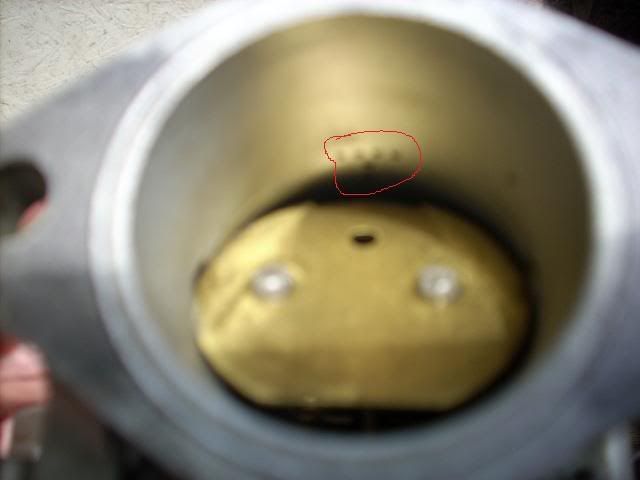
 . The hondas seems to run forever, a few on the small commercial boats by me look utterly neglected like they have been salvaged from the titanic and still purr out of the marina every morning to run all day. One tip to be aware of, the carb honda 50s have tiny (almost invisible) ports in the body of the carb for midrange throttle. The passages can get clogged easily with old gas. The motor will still run fine up to about half throttle, but if you get on it accelerating it will starve and miss. Fixing it is just cleaning the ports, no parts to buy, but I have read a few places dealers don't know that and will charge for new carbs.
Have fun with her

-
C Buchs
- Captain
- Posts: 605
- Joined: Thu Apr 23, 2015 6:49 pm
- Sailboat: MacGregor 26X
- Location: Camas, WA 98607
Re: Need Purchasing Advice 26X
Do you have any pictures or an exploded view of a carb that shows where this port is?
Jeff
Jeff
Honda BF50 carb port picture
This is a random carb pic I found online (not Honda) but its similar. Its been about 5 years, but I think there were 2 or 3 inlets in each bf50 carb. I used a single strand of copper unbraided from speaker wire to clear them.Do you have any pictures or an exploded view of a carb that shows where this port is?
Jeff