Anchoring

A forum for discussing topics relating to MacGregor Powersailor Sailboats
Wayne nicol
Captain
Posts: 645
Joined: Thu Feb 14, 2013 9:21 am
Sailboat: MacGregor 26M
Location: Queen CHarlotte Islands,B.C.---------------- lightning white 2012 26M "Merrylegs"

Re: Anchoring

Post by Wayne nicol »

nope, stainless will be solid, only on the galv anchor, that it is a coating,
my anchor came with the hole, so i just made the roller to fit.
really want to fit a system like this, thats what the hole is there for ...i think... :D
https://anchorsaver.com/
User avatar
mastreb
Admiral
Posts: 3927
Joined: Wed Feb 09, 2011 9:00 am
Sailboat: MacGregor 26M
Location: Cardiff by the Sea, CA ETEC-60 "Luna Sea"
Contact:

Re: Anchoring

Post by mastreb »

My concern with the Anchor Saver is that (especially with the new lower breaking point bolts) the anchor would come unset in a storm because the shear-pin would break under normal pulling when you aren't going across it in order to unset it, and then the spade would come unset just when you need it most. I'd like to see real-world storm usage data before I went with something like that, but i like the idea.
Wayne nicol
Captain
Posts: 645
Joined: Thu Feb 14, 2013 9:21 am
Sailboat: MacGregor 26M
Location: Queen CHarlotte Islands,B.C.---------------- lightning white 2012 26M "Merrylegs"

Re: Anchoring

Post by Wayne nicol »

that is a very good point Matt.
there are some other systems out there with sliding collars etc for tripping the anchor. i should look at this in greater depth! :D
User avatar
Russ
Admiral
Posts: 8402
Joined: Thu Oct 11, 2007 12:01 pm
Sailboat: MacGregor 26M
Location: Bozeman, Montana "Luna Azul" 2008 M 70hp Suzi

Re: Anchoring

Post by Russ »

mastreb wrote:My concern with the Anchor Saver is that (especially with the new lower breaking point bolts) the anchor would come unset in a storm because the shear-pin would break under normal pulling when you aren't going across it in order to unset it, and then the spade would come unset just when you need it most. I'd like to see real-world storm usage data before I went with something like that, but i like the idea.
+1

If the anchor is really stuck, then may be I should have set a release line. Otherwise, I'd rather not break it free in a serious blow when I need it most.

Easier to cut the line after the blow than be on the rocks. This idea sounds interesting, but not for me.
sirlandsalot
Engineer
Posts: 146
Joined: Sun Aug 11, 2013 3:50 pm
Sailboat: MacGregor 26M
Location: Kimberley, BC, Canada

Re: Anchoring

Post by sirlandsalot »

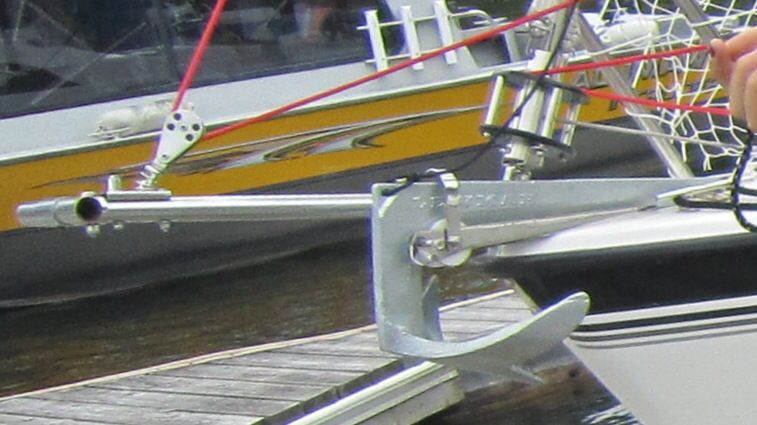
Not the best pic, but you can see the bolt through the anchor, it is not going anywhere, Now I have a trailer hitch pin through, much easier.


Image
User avatar
seahouse
Admiral
Posts: 2182
Joined: Sun Dec 07, 2008 9:17 pm
Sailboat: MacGregor 26M
Location: Niagara at Lake Erie, Ontario. 2011 MacM, 60 hp E-Tec
Contact:

Re: Anchoring

Post by seahouse »

Some other drilling hints in addition to the good drilling advice mentioned above...

The standard store-bought HSS drill set has point geometry that is suitable for the metals and materials that the average handyman will encounter. They can easily be resharpened on a grinder for improved performance in both harder or softer materials, but then will not perform as well in materials originally intended, until ground back to the original profile. A material might look “tougher” to drill, when it is simply the case that the geometry of the drill is optimized for another material.

Grinding the point angle on a standard HSS drill bit so it is more obtuse will help it through materials like stainless.

TiN drills are economical (get a set when they go on sale), harder on the surface than cobolt drills and a good choice for tougher materials... until they are sharpened for the first time, so the first sharpening should be delayed as long as possible.

Be careful with your feed force when opening up holes in tough material with any twist drill, it's easy to strip the shoulders off at the outside edges of the drill cutting edge. Chamfering the edges of the hole with a countersink larger then the finished hole will help ease the drill into the hole when you start.

Yeah, oil helps with the drilling too, more lubrication and some cooling. An alternative to oil, with more cooling and less lubrication, a saturated solution of baking soda and water works well, but you must keep the area completely flooded to prevent shock cooling of the cutting edges. (The baking soda will prevent the water from rusting your steel table and parts). As an environmentalist, this is a personal preference for me. (Has nothing to do with it being cheap too). :)

If your chips come off blue, or near blue and your drill is sharp you are likely turning at too high a speed, so reduce your drill rpms. Lower rpms will be needed when drilling materials like stainless (the cutting speed of stainless is much lower than regular steel), and also for larger holes. As a ballpark number, a 1/2” hole might be around 600 rpm or so, and a 1/4” 1200 rpm.

While stainless is not a coating, the high polish is not just for looks, it makes the metal much more corrosion resistant. You will find (especially in salt water) that the rough finish left by a twist drill will corrode (as rust) more quickly than the highly-polished exterior surfaces. So polish the inside of the hole (and chamfer the edges) if you're concerned about that. Some of the stainless on our Macs has a micropolished finish (it just looks plated) for better corrosion control.

Be aware that the finish on a galvanized anchor will still provide corrosion protection to the exposed metal in a drilled hole in the same process that protects your outboard motor from galvanic corrosion. It will still rust a bit, but at a much reduced rate than if the anchor were not galvanized. It's one of the beauties of galvanizing – the coat need not be continuous for protection.

-B. :wink:
Wayne nicol
Captain
Posts: 645
Joined: Thu Feb 14, 2013 9:21 am
Sailboat: MacGregor 26M
Location: Queen CHarlotte Islands,B.C.---------------- lightning white 2012 26M "Merrylegs"

Re: Anchoring

Post by Wayne nicol »

here is the other alternative i was looking at. more controlled- maybe prone to less than 100% success- but still better than nothing!
http://www.catchnrelease.com.au/
Three Gypsies
First Officer
Posts: 260
Joined: Wed Jul 24, 2013 9:06 am
Sailboat: MacGregor 26X
Location: Montgomery Alabama

Re: Anchoring

Post by Three Gypsies »

I have on the bow anchor since last spring. 40' of heavy 3/8 and 100' of 1/4" chain then 1/2" line. I tried it with the heavy chain at both ends and noticed a big difference in the anchor setting quicker and deeper with the heavy chain on the anchor end. Overkill but I love it. Quick set every time and takes guesswork out of anchoring. The all chain cuts way down on anchor swing in shallow anchorages since the mac does not have enough strength to drag it along the bottom in most winds. For a Bahamian moor in 10' drop the bow anchor, back up about 150'. drop second from stern, kill motor and pull boat back to the middle of the two lines. Once I set the anchors I clip a large caribbeaner down about 10' from where the snubber clips on to the chain and run the downstream nylon rode through it before up to the bow. The chain holds that line down like a kellet and well below the boat hull and fins so they don't rub the line as they swing over it. Second anchor stored on the stern with line always routed to the bow and stored in the bow locker. It is a lot of weight at the bow and I don't think its a good thing for the X. I ran a 4" pvc pipe straight down to below the V berth, then back under the V berth along the ballast tank to move the weight lower. About 100' fits under the V berth and the last 40' or so is the only weight up in the locker.


Please help my senile , to many drugs in the 60's , brain absorb this ,,,,

You have your heaviest chain next to the anchor , then lighter chain , then rope ?

I have 38' of 5/16 chain , and want to add 10' of heavy plastic coated chain to the rode .
The best advice I found was anchor , light chain , heavy chain , rope .

The theory behind this is
The heavy chain next to the rope acts as a shock absorber , the boat must lift this first , then the lighter chain ,
then finally tug on the anchor .

Its also suppose to make it easier to get the anchor up , you pull in the heavy chain first , then the lighter stuff . You don't lift it all at once .
User avatar
Seapup
Captain
Posts: 943
Joined: Tue Nov 16, 2010 7:05 am
Location: 2002 26x - Virgina Beach, Va

Re: Anchoring

Post by Seapup »

Please help my senile , to many drugs in the 60's , brain absorb this ,,,,

You have your heaviest chain next to the anchor , then lighter chain , then rope ?
:D My setup/needs are different than yours. With 140' of chain and shallow Chesapeake anchorages I generally only use the half of the rode closest to the anchor.
True in most cases but some people sail in a lot worst conditions than we try to and in those conditions I could see the anchor jumping out of the track and then bouncing on the side of the boat. With it there that can't happen.

Being out longer times where weather windows can't be picked to sail in I'd like to keep mine for that 'just in case' situation that I kind of get anal about :( . I am going to look at possibly making it easier to remove thanks to your suggestion :) ,

Sumner
You are right. The last thing you want is to be back at the helm wondering if the next wave is the one to rip your anchor off, or having it actually happen. :?

My primary concern for my local waters is getting pushed into a broach because the anchor protruding from the front digs into a wave causing resistance. My experience is that it does not take much of a short steep wave to put my anchor hanging off the front under. My opinion I posted in the anchor roller thread is that in questionable conditions the anchor should be off the roller all together. An anchor handy at the stern with line to the bow still covers you in an emergency. Its what works for me, but YMMV 8)
User avatar
mastreb
Admiral
Posts: 3927
Joined: Wed Feb 09, 2011 9:00 am
Sailboat: MacGregor 26M
Location: Cardiff by the Sea, CA ETEC-60 "Luna Sea"
Contact:

Re: Anchoring

Post by mastreb »

Just going to point out that a danforth style or Fortress/Guardian anchor that fits in the locker doesn't have any of these ancillary issues from being kept on the anchor roller. With a hand-payed, hand-retrieved anchor I find that getting the best holding power for anchor weight is important.

I also see no need for multiple weights of chain with our lighter boats. Here's my setup, which has never dragged although its only been exposed to moderate wave action, never a real storm. My bottoms are sand, mud, and rock, no grass.

1. Fortress FX-11. Fits in the anchor locker so it need not be kept on an anchor roller where it would be affected by wave action. I do have a bow roller, but because I anchor off the stern it's largely unused.
2. 20' of 5/16" chain, 200' of 9/16" line. Also fits in the anchor locker with the anchor, locker has a simple shackle to keep it closed. Probably 1/4" chain is sufficient.
3. 8 lb. galvanized grapnel used as a kellet.

It's now my usual habit to anchor off the stern gunnel cleats. This eliminates the "mac dance" and allows you to use the roller furling headsail as an anchor sail, because it's now at the un-anchored end of the boat. Just pulling out a small patch that will keep the boat stable in whatever level of wind you have--you can use the roller to customize the size of anchor sail to the wind and find that sweet-spot where the boat just steadies up against the wind and current and stays in one place. This also takes a lot of the rolling out of the wave action. Stern anchoring also allows a single person to anchor easily because you're right next to the helm, and you forward to set the anchor rather than reverse (not that that's a big deal). Being at the helm while unsetting the anchor helps a lot. I can think of no circumstance where anchoring off the bow is better than anchoring off the stern other than it looks a bit funny to others and the anchor locker is forward.

Maybe if you were in serious waves you'd want to be bow-to, but I'm not sure I'd be anchored in those kinds of waves anyway. I prefer to drift unanchored and offshore in that kind of wave action--much easier to sleep and way easier on the boat. I've drifted overnight a few times when offshore in the San Pedro where the bottom is 2500' or more down. It's not a big deal as long as you get at least an hour of GPS drift track before sleeping so you can predict your course overnight, and you keep your lights on. 1nm/hr. is typical drift here in SoCal, usually due north along the coast which is opposite the usual wind. You need to know for sure that no amount of current drift will get you anywhere near shore so don't do this unless you're 10+ miles out. I think we west-coast sailors spend more time offshore than easterners because we're only three miles off the continental shelf. Winds here are generally dead calm at night, so I drop sail because they fill and flap with every roll otherwise.

I pay out the anchor to the sea floor directly and count the arm-lengths to the floor. You'll have to figure out what your payout is, mine is about one fathom per pay. Then I do the math for a 7:1 scope and pay out the extra line, cleaning off at that point. Then I shackle the kellet to the rode and send it down the line.

The kellet will find its way down the rode as you pull the scope out under power. Under tension during setting, it will slide all the way to the chain-line splice. It keeps the chain on the ground, and with the Fortress dug in, the chain lays entirely on the seabed held down by the kellet, so you're getting the maximum holding power of the chain even when the boat pulls hard against it. The kellet is why my configuration has never unset.

Unsetting is easy: The kellet isn't dug in so it comes right up with the chain, and it never takes much more than going forward over the Fortress to unset it and haul it up. The combined weight of the anchor and kellet is still lower than any of the other types of anchors. I happen to use a grapnel screwed down as a kellet because I can also use it to hook rocks when beaching, but any weight on a shackle will work as a kellet. Making sure everything has multiple uses is important to me.

I also have a 2nd danforth (the stock "lunch hook" that came with the boat) and another matching rode in a 5'gallon bucket under the V-berth that I use for bahamian and fore-aft moors, but I've only done that once or twice when necessary amidst other boats.
Three Gypsies
First Officer
Posts: 260
Joined: Wed Jul 24, 2013 9:06 am
Sailboat: MacGregor 26X
Location: Montgomery Alabama

Re: Anchoring

Post by Three Gypsies »

All of our anchoring is either in the river or the shallow Gulf of Mexico .
I usually let out only the chain part of the rode , and a little rope . The chain is now about 40 ' with the addition of the heavy chain .

The heavy chain next to the rope will probably work well for our situation and rode .


Another writer sort of suggested we are going to far with our worries about anchoring .

I spent most nights during 2012 and 2013 at anchor . Rode out a tropical storm in Carrabelle and 60mph winds
in Crystal River ,,,, on anchor .

My anchor system is very important to the safety of my family and my ship . I want the best that I can afford and
carry aboard my little boat .
User avatar
Wind Chime
Captain
Posts: 866
Joined: Sun Jan 21, 2007 4:30 pm
Sailboat: MacGregor 26X
Location: Vancouver, B.C. Canada. 2000-26X, Suzuki-50hp, 8' Walker-Bay tender (with sailkit)
Contact:

Re: Anchoring

Post by Wind Chime »

mastreb wrote: Fortress FX-11. Fits in the anchor locker so it need not be kept on an anchor roller where it would be affected by wave action.
FYI: the FX-11 does not fit in tht anchor locker of an :macx:
mastreb wrote: I happen to use a grapnel screwed down as a kellet because I can also use it to hook rocks when beaching, but any weight on a shackle will work as a kellet. Making sure everything has multiple uses is important to me.
We use one of our 10 lb downrigger balls as a kellet. We also keep a grapnel-hook off the stern with 50 of line for emergency casting. I love the idea of it doing double-duty as our new anchor kellet ... great idea! This will also keep my balls dry :o
User avatar
Sumner
Admiral
Posts: 2375
Joined: Sun Jan 04, 2009 3:20 pm
Sailboat: MacGregor 26S
Location: SE Utah
Contact:

Re: Anchoring

Post by Sumner »

Three Gypsies wrote:..... My anchor system is very important to the safety of my family and my ship . I want the best that I can afford and carry aboard my little boat .
Yep for sure :) .

Unless you maybe go out for 3 days or less you can never be sure what the conditions might deteriorate to,

Sumner

============================
Our MacGregor 26-S

Our Endeavour 37

Our Trips to Utah, Idaho, Canada, Florida

Mac-Venture Links
User avatar
kurz
Admiral
Posts: 1322
Joined: Mon Dec 06, 2010 9:07 am
Sailboat: MacGregor 26M
Location: Zürich, Switzerland, Europe

Re: Anchoring

Post by kurz »

Three Gypsies wrote: My anchor system is very important to the safety of my family and my ship . I want the best that I can afford and
carry aboard my little boat .
Becouse of this I bought the Jamboo
http://www.jamboanker.com/index.php?opt ... &Itemid=41

Image
Three Gypsies
First Officer
Posts: 260
Joined: Wed Jul 24, 2013 9:06 am
Sailboat: MacGregor 26X
Location: Montgomery Alabama

Re: Anchoring

Post by Three Gypsies »

Sumner wrote:
Three Gypsies wrote:..... My anchor system is very important to the safety of my family and my ship . I want the best that I can afford and carry aboard my little boat .
Yep for sure :) .

Unless you maybe go out for 3 days or less you can never be sure what the conditions might deteriorate to,

Sumner

============================
Our MacGregor 26-S

Our Endeavour 37

Our Trips to Utah, Idaho, Canada, Florida

Mac-Venture Links


We go out for months at a time so we never know what kind of extremes we will have to anchor in .
We have been lucky that the few times we dragged , it was during the day and it was easy to notice .
We have had other boats drag down on us , so I am always wary of my neighbors , should the weather get bad .

In Carrabelle , after the tropical storm , our anchor had hooked into an antique anchor . It took us winching our anchor up with the sail anchor and my neighbor in his dinghy with a come-along to get it loose .

While running up Mobile Bay , ahead of hurricane Isaac , Our anchor came loose from the wave pounding and wrapped around the keel which I had down even though we were running on motor . We had to cruise like this all the way into the port of Mobile before I could stop and dive under to untangle it .
Post Reply