

I'm looking at buying a 1996 model and I understand there were some problems with the design/flaws/defects. So, what should I be looking for/wary of when I examine the boat?
thank you for your input.
bruce
Buying guide 26x 1996
-
Catigale

- Site Admin
- Posts: 10421
- Joined: Fri Jun 11, 2004 5:59 pm
- Sailboat: MacGregor 26X
- Location: Admiral .............Catigale 2002X.......Lots of Harpoon Hobie 16 Skiffs....Island 17
- Contact:
Re: Buying guide 26x 1996
There were Al rudder brackets on the early  which were not as robust as the SS ones used from 2000-on.
I wouldn't call it a defect, just something to inspect.
which were not as robust as the SS ones used from 2000-on. I wouldn't call it a defect, just something to inspect.
-
dlandersson

- Admiral
- Posts: 4984
- Joined: Fri Aug 27, 2010 10:00 am
- Sailboat: MacGregor 26X
- Location: Michigan City
Re: Buying guide 26x 1996
Amen, 
There's also some posts re: reinforcing the early rudder brackets.
There's also some posts re: reinforcing the early rudder brackets.
Catigale wrote:There were Al rudder brackets on the early
I wouldn't call it a defect, just something to inspect.
-
Mac26Mpaul

- Admiral
- Posts: 1066
- Joined: Mon Jun 14, 2010 2:36 am
- Sailboat: MacGregor 26M
- Location: Gold Coast, Australia 26M "Little Annie" Etec 50
Re: Buying guide 26x 1996
Think the pre 2000 boats had a balsa or foam cored deck didnt they  If so, I'd be having a good stomp around up there.
As to rudder brackets. They are still a pain now! The stainless ones get bent too dam easily........
If so, I'd be having a good stomp around up there.As to rudder brackets. They are still a pain now! The stainless ones get bent too dam easily........
-
Catigale
- Site Admin
- Posts: 10421
- Joined: Fri Jun 11, 2004 5:59 pm
- Sailboat: MacGregor 26X
- Location: Admiral .............Catigale 2002X.......Lots of Harpoon Hobie 16 Skiffs....Island 17
- Contact:
Re: Buying guide 26x 1996
I forgot about the balsa decks. Search Fora for model year differences for the scoop.
-
windypatrick

- Engineer
- Posts: 152
- Joined: Mon Jun 04, 2012 8:42 pm
- Sailboat: MacGregor 26X
- Location: Puerto Vallarta, MX
Re: Buying guide 26x 1996
Really?Mac26Mpaul wrote:Think the pre 2000 boats had a balsa or foam cored deck didnt they
As to rudder brackets. They are still a pain now! The stainless ones get bent too dam easily........
 I had pondered changing over to them (the stainless ones). The PO of my boat cracked the Port unit and I just finished doing a field repair, it is now gusseted and re-weldeded (over a prior repair) we'll see how it holds. If the new solution is no better, then perhaps some new engineering is in order. Can you describe the nature of the fault? (I don't mean to hijack the thread, just earnestly curious)
-
Tomfoolery

- Admiral
- Posts: 6135
- Joined: Tue Jul 05, 2011 7:42 am
- Sailboat: MacGregor 26X
- Location: Rochester, NY '99X BF50 'Tomfoolery'
Re: Buying guide 26x 1996
Thewindypatrick wrote:Really?Mac26Mpaul wrote:Think the pre 2000 boats had a balsa or foam cored deck didnt they
As to rudder brackets. They are still a pain now! The stainless ones get bent too dam easily........
rudder bracket is very different from the  system, which Mac26Mpaul has.
 The
originally had a cast aluminium bracket, which has since been replaced by a SS unit. I don't think there have been problems with the late-model SS version, but not knowing of problems doesn't mean there aren't problems. I just haven't heard of any. 
Check BWY for rudder heads for the
, and you'll see the two different styles (and the type if you filter on that).-
Ormonddude

- First Officer
- Posts: 383
- Joined: Thu Jun 07, 2012 2:08 am
- Sailboat: MacGregor 26X
- Location: Ormondbeach FL
Re: Buying guide 26x 1996
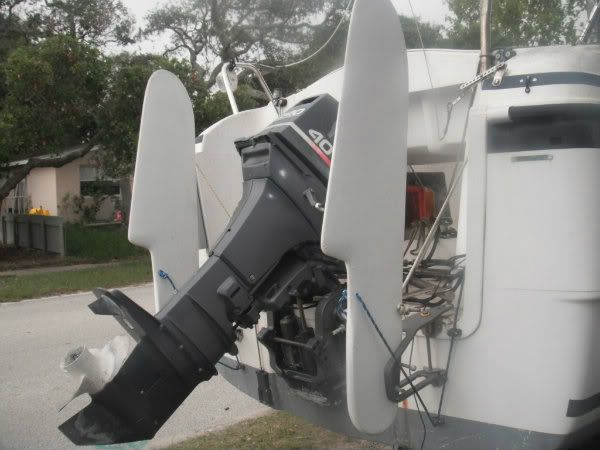
My 96 has no core on the main deck its solid glass and the cockpit is reinforced with 1/4" sheet aluminum My boat came with the 2nd generation over sized rudders and the brackets look bullet proof although aluminum also (there may have been a recall) Like with the spreader assembly (BTW check to see if you have the fixed spreaders) if not you need a spreader kit the old collapsing spreaders are deemed unsafe. The conversion is easy on the spreaders and only takes a couple of hours if your handy, if your not PM me I will walk you through it.

Re: Buying guide 26x 1996
No huge flaws or defects, just a few changes around 2000. The boat itself is quite durable, blisters are rare and the fiberglass comes right back glossy with some elbow grease. A well kept 96 could be a better package than a neglected 02. My main concern around that era would be the motor, then trailer and sails, all high ticket items. Together they could easily cost more than the price of the boat. Don't sweat the small stuff, it adds up but is half the fun. After you look at the boat carefully list anything that you think you will replace sometime in the future and price it out. Once you take a look at it just ask away any concerns you haveI'm looking at buying a 1996 model and I understand there were some problems with the design/flaws/defects. So, what should I be looking for/wary of when I examine the boat?
thank you for your input.
bruce

Here is an archive of the factory page with the list and pics from when they made the changes:
http://web.archive.org/web/200108070010 ... the_26.htm
RECENT CHANGES TO THE MACGREGOR 26
RETURN TO THE MACGREGOR WEB SITE TABLE OF CONTENTS
N0VEMBER 20,1999
We have made some significant improvements in the 26 over last few months.
LADDER. Since we moved the ballast tank vent to the front of the boat, we were able to get rid of the bump in the liner under the cabin entry and install a conventional ladder.
Here is a photo of the finished setup. The ladder hinges up and out of the way for easy access to the rear berth. Eliminating the bump in the liner allowed us to increase the size of the rear berth.
WATER TANK VENT. The vent has been moved from under the step. This has some big advantages: (1) A ring is bonded to the water tank top and surrounds the vent hole. It acts as a dam, trapping water that slops out the hole. A similar dam could not be placed on the vent under the step without making the step unreasonably high. (2) On a steep ramp, the old location occasionally let water spill into the boat when the vent was removed. This won’t happen with the forward vent. (3) The tank fills a bit faster. (4) There is no longer an air bubble that allows the water in the tank to make glurping noises when the boat is bouncing around at a mooring. (5) It is slightly easier to get at the vent in its new location. You no longer have to fool around with the step hold down bolts. This also makes it less likely you will forget to secure the step and invite a fall. However, you do have to lift the bunk hatch to see the vent hole.
STEERING. The cable and drum steering has been replaced with a very strong rack and pinion system (with a safe working load at the tiller of 2000 pounds, as opposed to the old system with a safe working load of 300 pounds.) These new units are extremely strong and durable. They are easier to install and service, and offer much smoother steering. We have raised the height of the pedestal to take the longer rack. The new units are long and thin, and take up a lot less room inside of the pedestal.
NEW HATCH RAILS. We have replaced the aluminum sliding and vertical hatch rails with 3/8” thick white polypropylene rails. These rails have been used by Schock Boats for some time now with great success. Unlike the aluminum rails, they don’t change color with time. They create less friction when sliding the hatch, and look a lot better. There is no more electrolysis between the stainless bolts and the aluminum in the rail. They have nice routed edges, and are polished to a gloss surface that matches the gloss on the rest of the deck.
STRONGER TABLE WITH NEW FASTENERS. The table has been beefed up and now feels as solid as a rock, in either the up or down position. We have replaced the stainless wing bolts with black molded knobs with generous diameters. They are easier to secure, and look a lot less mickey mouse.
NEW DECK STRUCTURE. For quite a few months, we have been building decks with an entirely new layup system. Much of the balsa wood has been replaced with a system of molded beams that make the deck liner a functional part of the deck structure.
We make the layup of the initial deck skins in the normal manner. Then, instead of balsa core, we lay in 1” x 1” flexible and spongy foam beams on 4 to 6” centers. These beams are then covered with 1 or 2 layers of 1.5 oz mat. Each layer of mat overlaps the mat on the adjacent beams. Before these layers cure, the liner is pressed into the molded deck. The liner compresses the foam and forces a good bond between the wet mat and the liner. The liner forms the inner skin of the deck structure. The results are quite spectacular. This system has some big improvements. Balsa created some problems. It tends to rot if water gets to it, and it was not always possible to assure that the balsa bonded solidly to the outer skin of the deck. The result was soft spots. No more. The foam can’t rot, but it really doesn’t matter. It is there only to create a shape for the fiberglass covering and the pressure needed to assure a good bond.
Until we made this change, the deck liners offered virtually no structural support for the deck. Now the decks are a lot stiffer, with no soft spots. They are also a lot lighter, which improves the boat’s inherent stability, trailerability and speed.
We are getting a lot of positive feedback from customers and dealers on how much stiffer the decks feel under foot.
TRAILER BRAKES. We have switched to trailer brakes that have stainless steel internal structures to keep corrosion under control. They are a major improvement, and should have greatly extended life.
FUEL TANK STORAGE AREA. When you looked at the roof of the fuel tank boxes, the underside of the seat layup was exposed, and was not too attractive. We have covered this area with a smooth white gel coat panel, and it really looks finished.
NEW CLEATS. The plastic mooring cleats have been replaced with really good looking highly polished stainless steel cleats. Each cleat has four 1/4” bolts rather than two, so they are a lot stonger.
SWITCH PANELS. We moved the switch panel to the deck liner just inside the cabin entry. To flip on the lights, you can just reach around from the cockpit
FUSES. We are now using 5 amp everywhere in the system. We had experienced problems with lower amperage fuses blowing prematurely.
CENTERBOARD CABLES. We have replaced the wire cables with a coated, abrasion resistant 5/16” line. This should eliminate all problems with electrolysis and corrosion. It is also a lot easier for the owner to change if the hoisting system suffers wear or damage. To reduce wear, we are carefully rounding the edges of the rope hole and the hole in the centerboard trunk thru which the line passes. The mast step has been redesigned to allow a larger hole for the centerboard line, and the bearing has been relocated to assure that the line passes straight down the hole, rather than hitting the sides.
DRAIN HOLE IN THE LINER. Directly below the hatch entrance, we are now drilling a ½” hole to allow excessive bilge water to move out onto the floor of the liner. This may sound pretty stupid at first, but there is a really good reason for making the change. Without this hole, it is possible for the boat to collect a really large, stability threatening load of bilge water. Since the liner floor area (the area that is carpeted) was essentially a water tight tub, the skipper would have no way of knowing that he had a big load of bilge water until the water had reached the level of the cutout in the face of the galley. It is true that the skipper should look in a hatch occasionally and check for bilge water, but I prefer a more obvious warning. When he steps in the cabin and ends up with water up to his ankles, he will get the message. I recommend that all owners of older boats make a similar hole. (Be really careful not to drill into the bump on the water tank found on the older boats.) You can see the hole location in the ladder photos that appeared earlier. The hole is high enough that a limited amount of bilge water will not dribble out onto the carpet.
ACCESS TO FOREDECK HARDWARE. In the past, if you wanted to add or remove hardware from the foredeck, you had to remove the panel on the underside of the front foam box and remove the foam. We have shortened the foam box, so you can now lay on the front bunk and reach up at the forward edge of the foam box and get to the nuts and bolts that hold the hardware. The access panel is no longer there.
-
DaveB

- Admiral
- Posts: 2543
- Joined: Mon Jan 07, 2008 2:34 pm
- Sailboat: MacGregor 26X
- Location: Cape Coral, Florida,1997 Mac. X, 2013 Merc.50hp Big Foot, sold 9/10/15
Re: Buying guide 26x 1996
On my 1997 MacX I have the same rudders and aluminum bracket you have in picture and after 4 years love them. Only stress is the pivit bolts in the arm steering, you may have to sleeve or redrill and add a larger diamiter bolts.
You also should have quick cams releases on both rudders incase you hit a submerged object or grounding so rudders kick up without damage to rudders and brackets.
Dave
You also should have quick cams releases on both rudders incase you hit a submerged object or grounding so rudders kick up without damage to rudders and brackets.
Dave
Ormonddude wrote:My 96 has no core on the main deck its solid glass and the cockpit is reinforced with 1/4" sheet aluminum My boat came with the 2nd generation over sized rudders and the brackets look bullet proof although aluminum also (there may have been a recall) Like with the spreader assembly (BTW check to see if you have the fixed spreaders) if not you need a spreader kit the old collapsing spreaders are deemed unsafe. The conversion is easy on the spreaders and only takes a couple of hours if your handy, if your not PM me I will walk you through it.
-
dlandersson
- Admiral
- Posts: 4984
- Joined: Fri Aug 27, 2010 10:00 am
- Sailboat: MacGregor 26X
- Location: Michigan City
Re: Buying guide 26x 1996
Moi also. "Love" is perhaps too strong a word. They DO bend or break - my port rudder bent after a 6.5 knot stint under sail - it may have been a preexisting condition. 
[quote="DaveB"]On my 1997 MacX I have the same rudders and aluminum bracket you have in picture and after 4 years love them. Only stress is the pivit bolts in the arm steering, you may have to sleeve or redrill and add a larger diamiter bolts.
You also should have quick cams releases on both rudders incase you hit a submerged object or grounding so rudders kick up without damage to rudders and brackets.
Dave
[quote="DaveB"]On my 1997 MacX I have the same rudders and aluminum bracket you have in picture and after 4 years love them. Only stress is the pivit bolts in the arm steering, you may have to sleeve or redrill and add a larger diamiter bolts.
You also should have quick cams releases on both rudders incase you hit a submerged object or grounding so rudders kick up without damage to rudders and brackets.
Dave
Last edited by dlandersson on Fri Oct 12, 2012 7:04 am, edited 1 time in total.
-
Tomfoolery
- Admiral
- Posts: 6135
- Joined: Tue Jul 05, 2011 7:42 am
- Sailboat: MacGregor 26X
- Location: Rochester, NY '99X BF50 'Tomfoolery'
Re: Buying guide 26x 1996
At first glance, I though you said "moai".dlandersson wrote:Moi also. "Love" is perhaps too strong a word.

A striking resemblance, don't you think.


-
DaveB
- Admiral
- Posts: 2543
- Joined: Mon Jan 07, 2008 2:34 pm
- Sailboat: MacGregor 26X
- Location: Cape Coral, Florida,1997 Mac. X, 2013 Merc.50hp Big Foot, sold 9/10/15
Re: Buying guide 26x 1996
I love things that have not failed me. Including my better half! ( My Boat)
Dave
Dave
dlandersson wrote:Moi also. "Love" is perhaps too strong a word.
DaveB wrote:On my 1997 MacX I have the same rudders and aluminum bracket you have in picture and after 4 years love them. Only stress is the pivit bolts in the arm steering, you may have to sleeve or redrill and add a larger diamiter bolts.
You also should have quick cams releases on both rudders incase you hit a submerged object or grounding so rudders kick up without damage to rudders and brackets.
Dave
-
dlandersson
- Admiral
- Posts: 4984
- Joined: Fri Aug 27, 2010 10:00 am
- Sailboat: MacGregor 26X
- Location: Michigan City
Re: Buying guide 26x 1996
Not since they chopped all their trees down. Nice example of self-destruction.
Catigale wrote:Î wonder if the teaky people of Easter island made wood boats?