

How can the Mac 26X sail close hauled better?
-
Catigale

- Site Admin
- Posts: 10421
- Joined: Fri Jun 11, 2004 5:59 pm
- Sailboat: MacGregor 26X
- Location: Admiral .............Catigale 2002X.......Lots of Harpoon Hobie 16 Skiffs....Island 17
- Contact:
Re: How can the Mac 26X sail close hauled better?
Correct - if you do two tacks you can get the angle to the wind by halving the difference of the two courses...except, in my experience, most boats dont point quite the same port and starboard...Ive measured as a large as 5 degrees difference, although 2 degrees is more common. My Mac, Island and Ericson all suffer from this, my Hobie and my Harpoon do not (although I havent measured the Harpoon that carefully..and Hobies dont point..!!)
-
opie

- Captain
- Posts: 895
- Joined: Tue Nov 16, 2004 5:40 am
- Sailboat: MacGregor 26X
- Location: Wilmington, NC
Re: How can the Mac 26X sail close hauled better?
Phil,
You've got my poor sailing head spinning... or is that puerile sailing head?
I have come around to your thinking after playing with a graphic...
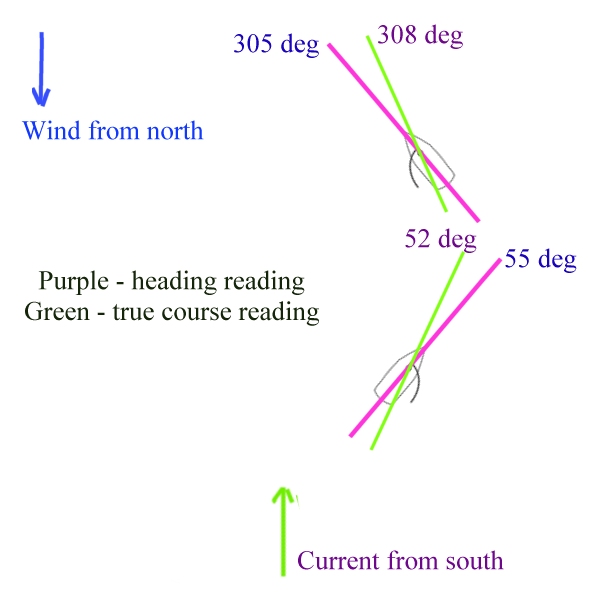
So, in my example above, the 'green' true GPS course bracket (port tack to starboard tack) of 104 degrees is not relevant to how close the boat is sailing into the wind. The 'blue' heading bracket of 110 degrees is the correct one to log down as this is the indication of how close you can sail to the wind. In my example, the 110 / 2 = 55 degrees. All my previous above discussion is therefore wrong when I drew lines on a Google map, if what you say is true, since I was using GPS true course bracket instead of GPS heading or compass heading bracket (one tack to the other tack). And by using the heading bracket method, true and apparent wind differentiation is not required, as it gets zeroed out by the bracket. Right?
ughh... on to more practice. Thanks for straightening me out.
But one comment. Your example showed 75 / 2 = 37.5 degrees close to the wind. This is not possible in a Mac from what I read from others. True?
You've got my poor sailing head spinning... or is that puerile sailing head?
I have come around to your thinking after playing with a graphic...
So, in my example above, the 'green' true GPS course bracket (port tack to starboard tack) of 104 degrees is not relevant to how close the boat is sailing into the wind. The 'blue' heading bracket of 110 degrees is the correct one to log down as this is the indication of how close you can sail to the wind. In my example, the 110 / 2 = 55 degrees. All my previous above discussion is therefore wrong when I drew lines on a Google map, if what you say is true, since I was using GPS true course bracket instead of GPS heading or compass heading bracket (one tack to the other tack). And by using the heading bracket method, true and apparent wind differentiation is not required, as it gets zeroed out by the bracket. Right?
ughh... on to more practice. Thanks for straightening me out.
But one comment. Your example showed 75 / 2 = 37.5 degrees close to the wind. This is not possible in a Mac from what I read from others. True?
-
Hamin' X

- Site Admin
- Posts: 3464
- Joined: Sat Aug 27, 2005 6:02 pm
- Sailboat: MacGregor 26X
- Location: Hermiston, OR-----------2001 26X DF-50 Suz---------------(Now Sold)
- Contact:
Re: How can the Mac 26X sail close hauled better?
The only thing that really matter in pointing, is apparent wind angle. All boats sail in apparent wind and it varies with course, amount and type of sail and true wind speed. All sails must be trimmed to apparent wind.
Just wanting to keep those old brain cells spinning.
~Rich
Just wanting to keep those old brain cells spinning.
~Rich
-
Catigale
- Site Admin
- Posts: 10421
- Joined: Fri Jun 11, 2004 5:59 pm
- Sailboat: MacGregor 26X
- Location: Admiral .............Catigale 2002X.......Lots of Harpoon Hobie 16 Skiffs....Island 17
- Contact:
Re: How can the Mac 26X sail close hauled better?
I think if you put up a GPS track and show an angle, you can report sailing with (FULL ANGLE/2) with respect to the true wind....your pointing wrt to the apparent wind will be somewhat tighter (lower angle) - is that right??
-
opie
- Captain
- Posts: 895
- Joined: Tue Nov 16, 2004 5:40 am
- Sailboat: MacGregor 26X
- Location: Wilmington, NC
Re: How can the Mac 26X sail close hauled better?
Catigale, I think I learned in school that if you show a formula wrong in one (extreme) instance then that formula is wrong, period.
With that in mind, what if the wind was N @ 2kts and the current was S @ 12kts (maybe Maine or England?) and all sails taken down. In this case the heading maybe 90 degrees as the boat lays to the current, and the gps track course could be 0 degrees....
So a gps captured track course, that I trusted before, can't be always counted on for windward performance.
So, if I use and practice all the tips given by members above, what is the definitive way of judging my performance to windward? (Without buying a wind aneometer and computer readout...)
HaminX - you are right of course about sailing according to A.Wind but how do you report to the gallery at the dinner table at night how you did? "40 degrees to the wind," may get you a raised eyebrow.
Do I have to buy THISat $759?

With that in mind, what if the wind was N @ 2kts and the current was S @ 12kts (maybe Maine or England?) and all sails taken down. In this case the heading maybe 90 degrees as the boat lays to the current, and the gps track course could be 0 degrees....
So a gps captured track course, that I trusted before, can't be always counted on for windward performance.
So, if I use and practice all the tips given by members above, what is the definitive way of judging my performance to windward? (Without buying a wind aneometer and computer readout...)
HaminX - you are right of course about sailing according to A.Wind but how do you report to the gallery at the dinner table at night how you did? "40 degrees to the wind," may get you a raised eyebrow.
Do I have to buy THISat $759?
-
Catigale
- Site Admin
- Posts: 10421
- Joined: Fri Jun 11, 2004 5:59 pm
- Sailboat: MacGregor 26X
- Location: Admiral .............Catigale 2002X.......Lots of Harpoon Hobie 16 Skiffs....Island 17
- Contact:
Re: How can the Mac 26X sail close hauled better?
I dont think the formulae are wrong, but describe different things
If you report angle to the wind by taking a compass reading when your tell tale points dead astern (true wind direction) and then report your compass heading close hauled, you report your 'angle to the true wind"
However, you are not really reporting your pointing (in my view) since if you are over-heeled and side-slipping, you might easily be making 10-15 degrees less direction-made-good than your compass heading.
The foolproof measurement (notwithstanding my asymmetric close-hauled performance note above) is a GPS track on a steady course on both tacks, assuming a constant wind of course - exactly what you advocated.
If you report angle to the wind by taking a compass reading when your tell tale points dead astern (true wind direction) and then report your compass heading close hauled, you report your 'angle to the true wind"
However, you are not really reporting your pointing (in my view) since if you are over-heeled and side-slipping, you might easily be making 10-15 degrees less direction-made-good than your compass heading.
The foolproof measurement (notwithstanding my asymmetric close-hauled performance note above) is a GPS track on a steady course on both tacks, assuming a constant wind of course - exactly what you advocated.
-
Phil M

- Captain
- Posts: 807
- Joined: Sun Jun 08, 2008 9:29 am
- Sailboat: Other
- Location: 44' Jeanneau, Saskatoon, SK, Canada
Re: How can the Mac 26X sail close hauled better?
A current would throw a monkeywrench into any simpe calculation.  But if you were sailing where there was no noticeble current, you might be able to roughly calculate how close you can sail into the wind just using your GPS tracks and trying to maintain a relatively constant speed on both starboard and port tacks.
Phil M
But if you were sailing where there was no noticeble current, you might be able to roughly calculate how close you can sail into the wind just using your GPS tracks and trying to maintain a relatively constant speed on both starboard and port tacks.Phil M
-
opie
- Captain
- Posts: 895
- Joined: Tue Nov 16, 2004 5:40 am
- Sailboat: MacGregor 26X
- Location: Wilmington, NC
Conclusions on "close hauled better?" and challenge
Phil and Catigale,
At the risk of beating this dead horse into the ground, I want to fully accept your conclusions. GPS tracks divided by 2 equals the angle to the wind. So there. Finis.
And reviewing notes from others, the real goal is getting to your upwind destination whether a harbor or racing buoy, so the pointing angle is secondary to that goal. So if I get this all correctly, the ideal angle and ideal speed into the wind zone can probably not be maintained so the trick is to sail up until slowing and then fall off to build speed and then sail up again, keeping sails full.
Here is my original gps track that I posted regarding the lake experience, with just relavant points shown and all other points removed.
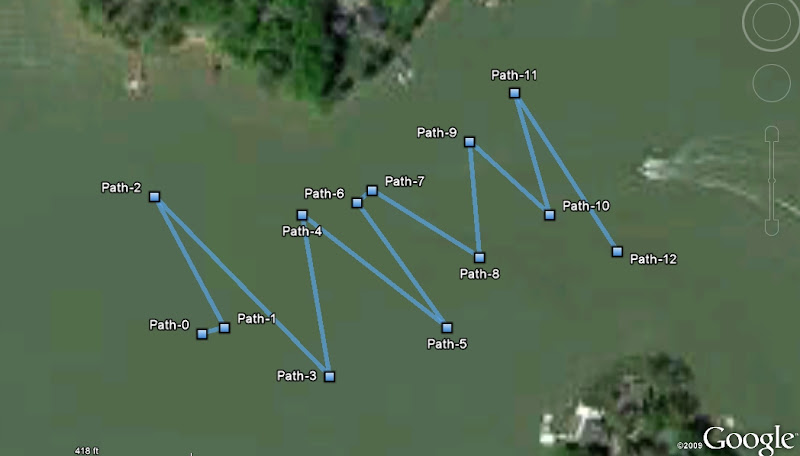
And here is my Garmin raw data of the points shown with my annotations written on it.

I want to issue a challenge for anyone else to post their own data of windward sailing using GPS tracks or other proof to try to unseat me from the throne of honor with my windward sailing degree figure of 74.25. Who can beat that? (Note: this was before I was educated here about not using all of a 150 genoa plus loose mainsail to try to go to windward...)
At the risk of beating this dead horse into the ground, I want to fully accept your conclusions. GPS tracks divided by 2 equals the angle to the wind. So there. Finis.
And reviewing notes from others, the real goal is getting to your upwind destination whether a harbor or racing buoy, so the pointing angle is secondary to that goal. So if I get this all correctly, the ideal angle and ideal speed into the wind zone can probably not be maintained so the trick is to sail up until slowing and then fall off to build speed and then sail up again, keeping sails full.
Here is my original gps track that I posted regarding the lake experience, with just relavant points shown and all other points removed.
And here is my Garmin raw data of the points shown with my annotations written on it.
I want to issue a challenge for anyone else to post their own data of windward sailing using GPS tracks or other proof to try to unseat me from the throne of honor with my windward sailing degree figure of 74.25. Who can beat that?
(Note: this was before I was educated here about not using all of a 150 genoa plus loose mainsail to try to go to windward...)-
Trouts Dream
- Captain
- Posts: 663
- Joined: Thu Dec 14, 2006 12:10 pm
- Sailboat: MacGregor 26X
- Location: Calgary, Alberta--1997 26X--Yamaha 90HP 2 Stroke....grunt, grunt
Re: How can the Mac 26X sail close hauled better?
Thats about The angle I get with my asymetrical spinnaker. Have found that less is more on the front sail in most cases when trying to close haul.
Best I have done is 90 total or 45 to wind. In light winds its more like 110 or 55 to wind.
Best I have done is 90 total or 45 to wind. In light winds its more like 110 or 55 to wind.
-
Phil M
- Captain
- Posts: 807
- Joined: Sun Jun 08, 2008 9:29 am
- Sailboat: Other
- Location: 44' Jeanneau, Saskatoon, SK, Canada
Re: How can the Mac 26X sail close hauled better?
45 degrees on a Mac?Trouts Dream wrote: Best I have done is 90 total or 45 to wind. In light winds its more like 110 or 55 to wind.
Hmmm, I want some of what you're smoking ... Phil M
-
Rob S
- Deckhand
- Posts: 48
- Joined: Tue Oct 31, 2006 6:04 pm
- Sailboat: Venture 25
- Location: Ohio River, Kentucky
Re: How can the Mac 26X sail close hauled better?
Opie,
I had fun racing my over the last 3 years until I sold it this Spring. We had to work very hard to not come last in our mixed fleet, but usually didn't. I would say my GPS tracks showed tacking angles of around 50 to 55 degrees depending on conditions, so yes, it's possible to do better than the sawtoothpattern in your pictures. Forgive me if I'm repeating info or preaching to the choir.
I think there's a clue here unless I'm misunderstanding you......
>>>>>In the past 3 years I looked up at the wind arrow and was feeling more warm and fuzzy than I should because apparent wind gave me the illusion that I was 45 degrees to the wind but I was not even close all those times in actuality.<<<<
So, are you looking up at the wind arrow and assuming that if it shows about 45 degrees from centerline, then that's the best you can do?? You're maybe not pushing hard enough...... If you have the boat maintaining speed, and trimmed in, and about 50 to 55 degrees off true wind, then you should be seeing an apparent wind angle on your pointer more like 35 degrees off center, not 45.
But achieving it is tricky, as others have said here, you have to go for speed first, angle later. Coming out of a tack you need to fall off MORE than 45 degrees from the true wind and trim the sails to that so the boat starts accelerating. As it speeds up, you will need to progressively trim in because the forward speed causes an apparent wind shift more to the front. Once you are upto speed, you then go through a progressive process where you head up a nibble, trim in a nibble, head up a nibble, trim in a nibble, etc until you're trimmed in all the way (genoa snugged close to the the shroud, boom close to centerline) and maintaining speed, all easier said than done. You have to be patient and give it time to accelerate otherwise it's just like trying to pull away from a stop light in fourth gear in a stick-shift car, it just won't go! All this assumes your sails are in good shape, and your rigging is correctly tuned and tensioned.
Other comments..... no matter what anyone says, for Close Hauled, pointing as high as is possible, you need TWO sails correctly trimmed (or the boat is "unbalanced" with the rudders trying to keep it on course but acting like brakes ) and centerboard fully down...... yes, it is true that the boat will handle better in strong winds (or mainsail only) with the centerboard 3/4 to 1/2 down, but its leeway is increased considerably. That is a compromise you accept to have better control and not have it rounding up on you in every gust.
Another comment..... >>>>GPS tracks divided by 2 equals the angle to the wind. So there. Finis.<<<<
Um... er.... No. GPS tracks divided by 2 equals combined angle to the wind plus leeway angle. A compass heading kind of assumes the boat will go where it's centerline is pointing, but it doesn't. It drifts a little sideways as if in an invisible current. A racing yacht has an efficient keel that minimizes leeway angle. The Mac has a streamlined plank! The GPS knows all, sees all, and doesn't care about angles! It just shows where you was!
Other tricks...... Getting the main trimmed in on an is a problem because it has no traveler. To point, you need the "sheeting angle" low i.e. boom close to centerline, but with only a single mainsheet, the harder you trim in, the more the mainsheet pulls the boom down towards the center console, flattening the mainsail and hence depowering it. I used a double mainsheet in an "A" configuration, somewhat like this...
http://macgregorsailors.com/modt/index.php?view=656 It does the same as a traveler.... as you tension the windward mainsheet, the boom is pulled across without so much downforce, retaining mainsail shape and power. Windward mainsheet controls boom position, leeward mainsheet controls how open or closed the leech is (twist) and you just play with them to get the best combination according to conditions and what you need. It's also great in stronger winds too since you can let the boom fall off to leeward with a slackened windward mainsheet, and tension the leeward sheet down hard to flatten and depower the mainsail..... WAAAY better than a single mainsheet in which all you can do to keep the boat on its feet is let out the mainsheet..... the boat comes back up, but the main is luffing.
Last trick..... I removed the captain's seat and tied a short strong line between the rudder tie-down cleats. Shackled to the line I had a couple of blocks through which I had the genoa sheeted on a longer than standard jib sheet. This allowed a sheeting angle for the genoa that was a bit lower than the rear tracks would allow. This is probably too hardcore for most..... the jibsheet occupies a lot of the cockpit, but I was serious about racing! A jib will point higher than a genoa because when sheeted fully in, its sheeting angle (angle between the sail and the boat centerline) is lower than a genoa can physically achieve (it's outside the shrouds). This means for two boats with fully sheeted in foresails, both sails at the same angle to the wind (angle of attack), the one with the jib will have it's centerline a few degrees closer to the wind than the genoa boat. But in lighter winds, the genoa generates more power than a jib, so your choices are..... sail higher but slower, or lower but faster. But as Leon mentioned (I agree with everything he said) slow = leeway. Your boat with jib may have a high compass heading, but your GPS track may show you were doing a lot of sideways. Save the jib for when the winds are too overpowering for the genny.
I had fun racing my
over the last 3 years until I sold it this Spring. We had to work very hard to not come last in our mixed fleet, but usually didn't. I would say my GPS tracks showed tacking angles of around 50 to 55 degrees depending on conditions, so yes, it's possible to do better than the sawtoothpattern in your pictures. Forgive me if I'm repeating info or preaching to the choir.I think there's a clue here unless I'm misunderstanding you......
>>>>>In the past 3 years I looked up at the wind arrow and was feeling more warm and fuzzy than I should because apparent wind gave me the illusion that I was 45 degrees to the wind but I was not even close all those times in actuality.<<<<
So, are you looking up at the wind arrow and assuming that if it shows about 45 degrees from centerline, then that's the best you can do?? You're maybe not pushing hard enough...... If you have the boat maintaining speed, and trimmed in, and about 50 to 55 degrees off true wind, then you should be seeing an apparent wind angle on your pointer more like 35 degrees off center, not 45.
But achieving it is tricky, as others have said here, you have to go for speed first, angle later. Coming out of a tack you need to fall off MORE than 45 degrees from the true wind and trim the sails to that so the boat starts accelerating. As it speeds up, you will need to progressively trim in because the forward speed causes an apparent wind shift more to the front. Once you are upto speed, you then go through a progressive process where you head up a nibble, trim in a nibble, head up a nibble, trim in a nibble, etc until you're trimmed in all the way (genoa snugged close to the the shroud, boom close to centerline) and maintaining speed, all easier said than done. You have to be patient and give it time to accelerate otherwise it's just like trying to pull away from a stop light in fourth gear in a stick-shift car, it just won't go! All this assumes your sails are in good shape, and your rigging is correctly tuned and tensioned.
Other comments..... no matter what anyone says, for Close Hauled, pointing as high as is possible, you need TWO sails correctly trimmed (or the boat is "unbalanced" with the rudders trying to keep it on course but acting like brakes ) and centerboard fully down...... yes, it is true that the boat will handle better in strong winds (or mainsail only) with the centerboard 3/4 to 1/2 down, but its leeway is increased considerably. That is a compromise you accept to have better control and not have it rounding up on you in every gust.
Another comment..... >>>>GPS tracks divided by 2 equals the angle to the wind. So there. Finis.<<<<
Um... er.... No. GPS tracks divided by 2 equals combined angle to the wind plus leeway angle. A compass heading kind of assumes the boat will go where it's centerline is pointing, but it doesn't. It drifts a little sideways as if in an invisible current. A racing yacht has an efficient keel that minimizes leeway angle. The Mac has a streamlined plank! The GPS knows all, sees all, and doesn't care about angles! It just shows where you was!
Other tricks...... Getting the main trimmed in on an
is a problem because it has no traveler. To point, you need the "sheeting angle" low i.e. boom close to centerline, but with only a single mainsheet, the harder you trim in, the more the mainsheet pulls the boom down towards the center console, flattening the mainsail and hence depowering it. I used a double mainsheet in an "A" configuration, somewhat like this...http://macgregorsailors.com/modt/index.php?view=656 It does the same as a traveler.... as you tension the windward mainsheet, the boom is pulled across without so much downforce, retaining mainsail shape and power. Windward mainsheet controls boom position, leeward mainsheet controls how open or closed the leech is (twist) and you just play with them to get the best combination according to conditions and what you need. It's also great in stronger winds too since you can let the boom fall off to leeward with a slackened windward mainsheet, and tension the leeward sheet down hard to flatten and depower the mainsail..... WAAAY better than a single mainsheet in which all you can do to keep the boat on its feet is let out the mainsheet..... the boat comes back up, but the main is luffing.
Last trick..... I removed the captain's seat and tied a short strong line between the rudder tie-down cleats. Shackled to the line I had a couple of blocks through which I had the genoa sheeted on a longer than standard jib sheet. This allowed a sheeting angle for the genoa that was a bit lower than the rear tracks would allow. This is probably too hardcore for most..... the jibsheet occupies a lot of the cockpit, but I was serious about racing! A jib will point higher than a genoa because when sheeted fully in, its sheeting angle (angle between the sail and the boat centerline) is lower than a genoa can physically achieve (it's outside the shrouds). This means for two boats with fully sheeted in foresails, both sails at the same angle to the wind (angle of attack), the one with the jib will have it's centerline a few degrees closer to the wind than the genoa boat. But in lighter winds, the genoa generates more power than a jib, so your choices are..... sail higher but slower, or lower but faster. But as Leon mentioned (I agree with everything he said) slow = leeway. Your boat with jib may have a high compass heading, but your GPS track may show you were doing a lot of sideways. Save the jib for when the winds are too overpowering for the genny.
-
DaveB

- Admiral
- Posts: 2543
- Joined: Mon Jan 07, 2008 2:34 pm
- Sailboat: MacGregor 26X
- Location: Cape Coral, Florida,1997 Mac. X, 2013 Merc.50hp Big Foot, sold 9/10/15
Re: How can the Mac 26X sail close hauled better?
Sailing as close to 45 degrees on a MacX is posable with a 105% jib and Main if they are fairly new and no current in 10-15 knot true Wind beating to Windward. I have done it many times (even tacked thru 85 degrees a few times just to test the rig) but thats with a new Jib and 3 year old Main Sail, lots of looking up.
The jib brings your lines inside so you can point better, depending on wind ,slack off main sheet a bit so you get even flow . Tell Tales are best way to ck flow going past sails.
I plan on getting a new main with full battens at top two, this is the area that is first to streach and full battens will keep the sail tight aloft as it ages.
Sometimes it is better to fall off 5 degrees when current or the condition requires this to make better headway, this is usually done in 8 knots or less True Wind.
Dave
The jib brings your lines inside so you can point better, depending on wind ,slack off main sheet a bit so you get even flow . Tell Tales are best way to ck flow going past sails.
I plan on getting a new main with full battens at top two, this is the area that is first to streach and full battens will keep the sail tight aloft as it ages.
Sometimes it is better to fall off 5 degrees when current or the condition requires this to make better headway, this is usually done in 8 knots or less True Wind.
Dave
Phil M wrote:45 degrees on a Mac?Trouts Dream wrote: Best I have done is 90 total or 45 to wind. In light winds its more like 110 or 55 to wind.
Phil M
-
Catigale
- Site Admin
- Posts: 10421
- Joined: Fri Jun 11, 2004 5:59 pm
- Sailboat: MacGregor 26X
- Location: Admiral .............Catigale 2002X.......Lots of Harpoon Hobie 16 Skiffs....Island 17
- Contact:
Re: How can the Mac 26X sail close hauled better?
Rob - the GPS track does reflect the true performance of pointing since it will show the leeway effect. The angle of the tracks would reflect the true course angle to the true wind, assuming the boat handles symmetrically on port and starboard. The bow angle to the true wind would be less than this, of course.Another comment..... >>>>GPS tracks divided by 2 equals the angle to the wind. So there. Finis.<<<<
Um... er.... No. GPS tracks divided by 2 equals combined angle to the wind plus leeway angle. A compass heading kind of assumes the boat will go where it's centerline is pointing, but it doesn't.
Re: How can the Mac 26X sail close hauled better?
I tend to get apparent wind darn close to on the nose. Often I ride the sails right on the edge of luffing when there is a lot of wind to keep everyone happy when beating. I tend to tack and run the same track as some of the other cruisers out there.
I did have problems with the boat rounding into the wind when i 1st got it and I (based on the recommendations from this forum) tightened up the shrouds to a fine low note. That helped quite a bit with rounding and heeling. Didn't bother with the LOOS guage but if I see one on sale, I'll give it a shot.
Some seem to have trouble tacking in light winds. Compared to a Hobie, this boat is a dream to tack. Just be easy on the helm using a slow but constant turn (too fast acts like a brake). The big secret: do not release the Jib/Genoa until you are through the tack as it will pull you around.
Playing the travelers can help trim the boat and hence increase your speed and pointing.
Jim
I did have problems with the boat rounding into the wind when i 1st got it and I (based on the recommendations from this forum) tightened up the shrouds to a fine low note. That helped quite a bit with rounding and heeling. Didn't bother with the LOOS guage but if I see one on sale, I'll give it a shot.
Some seem to have trouble tacking in light winds. Compared to a Hobie, this boat is a dream to tack. Just be easy on the helm using a slow but constant turn (too fast acts like a brake). The big secret: do not release the Jib/Genoa until you are through the tack as it will pull you around.
Playing the travelers can help trim the boat and hence increase your speed and pointing.
Jim
-
Trouts Dream
- Captain
- Posts: 663
- Joined: Thu Dec 14, 2006 12:10 pm
- Sailboat: MacGregor 26X
- Location: Calgary, Alberta--1997 26X--Yamaha 90HP 2 Stroke....grunt, grunt
Re: How can the Mac 26X sail close hauled better?
The rule I use when tacking the mac is wait until the main just starts to fill before throwing off the foresail. This works every time no matter what the wind. in very light winds this can take many seconds, and in high winds it happens fast but just make sure the person tacking the foresail is aware of when the main is filling.