Hamin' X wrote:Yes, I use dissipators on my communication towers.
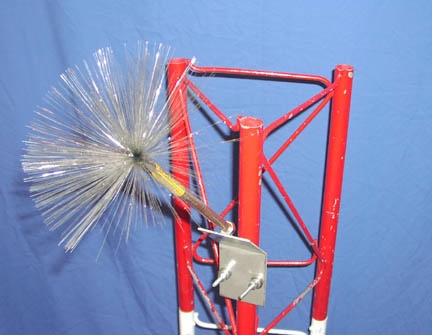
... I make my own from SS cable. I use the KISS principle and avoid the (
lightning-channeling) problem.
The secret is to have many sharp points. The dissipators have many discharge points that allow for the discharge to occur, without reaching the critical threshold.... The charge in the clouds is built up as a static charge, as is the charge from the earth. When the charge on either side is lessened, so is the chance of discharge.
~Rich
Rich, is that one of your homebuilt "wire broom" dissipators? I'd like details on how you make them.
There's a lot of uncertainly about lightning, its propagation and behavior ... and how to defend ourselves from it. Seems to me that we can either provide a big fat conduit to carry the lightning "away to a safe place", or make our boats less attractive to lightning by lowering our static potential. (Aw, heck, you said the same three years ago in the "Lightning strike scare" thread.)
"Make myself less attractive to lightning" was the original purpose of lightning rods, and the reason they were sharp-pointed ... their inventor had experimented with "Leyden jar" capacitors, and observed that a jar with a pointed electrode out the top leaked-off its electrical potential into the atmosphere. And he'd observed, with a kite and a key, that the electrical potential of a thunderstorm is the same as the static electricity "natural philosophers" were starting to explore. Was "Poor Richard" justified? History says yes.
Does the "broom" dissipator
reduce our chances of a lightning strike? Seems so. Does it
eliminate the potential? You, being a ham radio operator, know more than I do about that - but I've seen enough broom dissipators in use that I'm encouraged to buy, or build, one for Bossa Nova.
Do you use one on your masthead?
Thanks -
Rick


 Ugh. That's a better than one-in-eight chance ... too big to "ostrich away"....